

PrimoSummit™
Systems of Ethics
and Reasoning
Before the ballot. Before the boardroom.
There is a conversation.
The First Argument
Before the ballot. Before the boardroom. Before the policy debate or the personal reckoning that will shape another person's life.
There is a conversation.
The kind that happens at a kitchen table, quietly, at an hour when the rest of the household has withdrawn. Your adolescent is making a case. You are listening. The argument has a structure you did not teach them directly. The reasoning moves from premise to consequence. The position holds a considered weight.
Something in you stills.
This is not the confident noise of a child who has learned to sound persuasive. This is the quieter work of a young mind organizing a position from evidence rather than from feeling alone. The two things are different. The first produces volume. The second produces judgment.
This is not a story about debate practice.
This is a story about what happens in the human mind when the capacity for abstract reasoning meets the demand to act rightly in a complex world.
What No One Prepares You For at Thirteen and Beyond
The parenting literature prepared you for milestones. It described adolescent development the way a syllabus lists topics: identity formation, peer influence, emotional regulation. Necessary. Accurate. Insufficient.
What it did not prepare you for is the particular quality of the uncertainty you carry now.
The uncertainty of the newborn years was physical. You could hold it. You could see it. You could respond to it directly.
The uncertainty of these years lives somewhere else. It lives in conversations that end abruptly. In positions your adolescent holds with conviction that you cannot immediately locate in anything you deliberately taught them.
The question that surfaces is not whether they are developing. The question is whether the development is acquiring structure.
You watch them reason through a difficult situation. The logic is almost there. The conclusion lands somewhere that troubles you, though you cannot immediately say why. Something in the argument's architecture is missing. A step was skipped. A consequence was not traced.
This is the precise weight of Phase X for a mentor who is paying attention.
Reasoning without structure produces confident errors. The errors are not visible until a decision has already been made.
What Developmental Science Found at the Summit
The Architecture of Adolescent Moral Cognition
Between early adolescence and young adulthood, a specific transformation takes place in the human reasoning system. It is not dramatic. It does not announce itself. It operates through the accumulation of thousands of small intellectual encounters.
The prefrontal cortex continues its development well into the mid-twenties. During the adolescent years, this region is actively constructing the neural scaffolding through which ethical reasoning becomes possible. The adolescent brain is not a deficient adult brain. It is a brain in the particular work of building a system for integrating logic with consequence.
Research in moral development establishes that moral reasoning moves through progressive stages. The movement from conventional rules-based compliance toward principled reasoning depends on structured encounter with genuine moral complexity. The encounter must be real enough to resist easy resolution. It must be guided closely enough to prevent the adolescent from retreating to the first available answer.
Research on moral intuition adds a further precision. The adolescent reasoning system generates moral intuitions before it generates moral arguments. The intuitions are fast. They are often accurate. They are also frequently wrong in ways that careful structured reasoning would have detected.
Ethical reasoning is a learnable discipline. It develops through structured, guided engagement with genuine moral complexity, applied consistently across a developmental window that has a distinct beginning and a definite arc.
This is the distinction between a young adult who reasons ethically because the situations are familiar and one who reasons ethically because the reasoning is a practiced architecture.
What a Mentor at This Stage Is Actually Asking
When you wonder whether your adolescent is making good decisions, you are asking something more specific than it sounds.
You are asking whether their reasoning has a structure that will hold when you are no longer in the room.
That is the real question at this stage. The one that rides alongside you through conversations that do not resolve cleanly. The one that surfaces when you watch them choose and feel the distance between how they arrived at the choice and how you would have approached it.
You have guided them through twelve prior phases of structured engagement. What this stage requires of you is different from all of those.
A guide at Phase X does not instruct. A guide at Phase X facilitates. They create the conditions for a disciplined encounter between the young person's reasoning and genuine moral complexity. They ask the question that slows the impulse. They surface the consequence that the first answer overlooked.
This role has a specific name in the developmental literature. It is not parent in the managing sense. It is not teacher in the instructing sense.
Accumulated life experience is necessary. It is the material the framework operates on. The framework is what turns experience into reasoning, and reasoning into the kind of judgment that holds under pressure.
Phase X: PrimoSummit™
An Institutional Statement of Scholarly Purpose
System Identity and Phase Position
MireonSpero™ First Impressions™ is a structured global learning continuum designed to guide cognitive development from early visual perception through organized abstract reasoning. The system advances through ten defined phases, each corresponding to a distinct developmental window and governed by an internal sequence that reflects the progression of the human mind from sensory encounter to structured thought.
Phase X, designated PrimoSummit™, represents the culminating layer of this continuum. It operates within the developmental window of thirteen years and beyond, a period characterized by the active development of abstract moral reasoning, the construction of principled ethical frameworks, and the emerging capacity to trace individual decisions through the complex systems in which they operate.
This phase does not seek to accelerate the natural development of ethical reasoning. It seeks to organize the conditions within which that development takes place, providing the mentor with a structured framework for consistent, evidence-informed engagement across the full span of the phase window.
Scholarly Foundation
The design of PrimoSummit™ draws upon established findings in moral psychology, cognitive development, and applied systems reasoning.
The phase draws upon longitudinal research in staged moral development, triarchic models of moral cognition, the relationship between moral intuition and post-hoc rationalization, systems thinking frameworks for ethical decision-making, and developmental theory on internally derived ethical identity. Each informs a specific dimension of the phase's facilitation architecture.
Three Governing Principles
The phase builds the habit of slowing moral intuition toward structured examination. Each engagement invites the learner to surface the reasoning behind the position before the position is acted upon. Speed is not rewarded. Depth is.
Ethical reasoning in this phase is connected to real domains: civic structures, technological systems, ecological consequence, historical precedent. The reasoning is applied to the actual complexity of the world the learner inhabits and will shape.
The phase moves the learner progressively from applying frameworks supplied by external authority toward constructing principled positions from their own reasoned examination. The mentor's role reduces as the learner's internal reasoning architecture becomes more reliable.
The Mentor as System Operator
PrimoSummit™ is designed for the mentor, not for the learner in isolation. The materials provide the structured content. The mentor provides the relationship through which that content becomes a genuine reasoning encounter. The quality of the mentor's facilitation, their willingness to ask the destabilizing question rather than accept the first adequate answer, determines the depth of the engagement.
Mentors are guided to observe the learner's reasoning within a structured framework of reference points. Changes in argument construction, evidence integration, and the tracing of consequence across systems are documented not as measures of moral character, but as evidence of a developing ethical reasoning architecture. This observational practice serves two purposes. It creates a continuous record of the phase experience. It also trains the mentor's attentiveness to the specific forms of reasoning progress that this developmental window produces.
PrimoSummit™ is an enrichment framework. It is designed to complement attentive mentorship and may be used alongside established educational guidance. It is not a therapeutic intervention. It does not replace professional developmental evaluation. It does not function as a diagnostic instrument.
No assurance is made regarding ethical development, moral reasoning outcomes, or the pace of value formation. Development remains variable, shaped by the individual profile of the learner and the environment in which they are held.
The system offers a designed framework. The learner brings their own readiness, their own history, and their own moral complexity to that framework. These are not the same thing, and this institution does not conflate them.
Three Editions. One Governing Structure.
Each occupies the same phase window. Each addresses the same developmental period. The distinction between them is one of scope, depth, and operational completeness.
Origin Edition
The foundational architecture of Phase X. Moral reasoning anchors give the mentor a reference system for daily and weekly engagement. Evidence-grounded inquiry frameworks provide language for what is being observed and why it carries developmental significance. Documentation instruments create a structured record of the phase as it unfolds.
This is where disciplined moral reasoning begins. Guided. Observed. Documented.
Prestige Edition
The Prestige Edition deepens engagement through calibrated progression across four sequential reasoning clusters. Each engagement operates within a defined inquiry framework designed to support deliberation, integration of evidence, and the tracing of consequence through connected systems.
The mentor is guided in what to ask, how to hold the space for genuine complexity, and how to observe the learner's reasoning within an organized structure of reference points.
Legacy Edition
The most complete expression of Phase X. The Legacy Edition integrates the full governing playbook with a coordinated suite of inquiry tools: ethical futures modeling resources, global systems mapping instruments, narrative ethics production frameworks, a leadership reasoning ledger, and multi-year tracking instruments. Every element operates within one coherent, sustained framework.
The Ethosynthesis™ Master Playbook
A five-year sequenced framework for guided ethical reasoning development, structured from the earliest stage of Phase X through its full span. Each year is organized within a progressive framework that deepens in structured complexity as the learner's moral reasoning architecture matures. Inquiry anchors appear at defined intervals. Mentor facilitation sequences are embedded throughout.
The mentor who enters Phase X with the Playbook does not face the week wondering where to take the reasoning. The trajectory has already been designed. The structure exists. The practice is defined.
Reasoning in Service of Formation
PrimoSummit™ is delivered through three primary instruments, each designed to serve a distinct function within the phase.

PrimoCard™
The primary inquiry stimulus of Phase X.
Each card presents a moral scenario, ethical domain, or systems-level situation calibrated to the documented parameters of adolescent moral reasoning capacity. The content is substantive enough to resist easy resolution. The framing is precise enough to support structured examination rather than opinion exchange. No single card produces a predetermined conclusion. Each card is designed to generate the kind of genuine complexity that developing ethical reasoning must encounter to deepen.
A reasoning instrument, not a discussion prompt.
Bright Recall Card™
Structured memory support for the mentor.
The Bright Recall Card™ provides session references, facilitation anchors, and inquiry frameworks that allow the mentor to hold each engagement with intentionality and retain what was observed. It is the mentor's companion within each encounter, designed so that facilitation remains structured and observation remains precise even when the engagement moves into territory the mentor did not anticipate.
GuideCard™
Direction for deliberate facilitation.
The GuideCard™ provides sequenced instructions for each engagement within the phase. Which inquiry to open with. How to hold the space when the learner retreats to the first available answer. What to observe. When to deepen. When to allow the complexity to settle without resolution. Each GuideCard™ carries the mentor through a defined facilitation structure so that the quality of the encounter is built into the practice rather than dependent on the mentor's instinct in any given session.
PrimoSummit™ Phase Set
The three instruments of Phase X do not function as separate interventions. They form a coordinated suite, designed to work together across the full arc of each engagement.

Each card in this set presents moral and systems-level complexity calibrated to the documented parameters of adolescent reasoning development. The set delivers the precise quality of ethical encounter that the developing reasoning architecture is equipped to engage with at this stage.
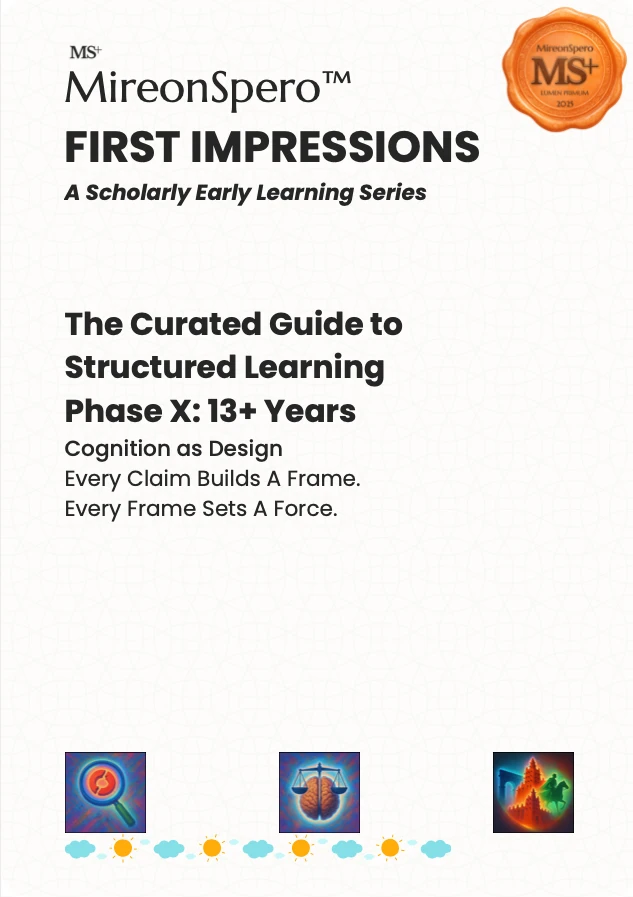
The mentor's operational reference across the phase. The Guide frames each encounter within a coherent facilitation structure, providing the sequencing, pacing, and observational language that transform a conversation into a deliberate act of guided reasoning development.
The structured reflection layer of the phase experience. These materials anchor what was observed, support continuity across engagements, and give the mentor a disciplined record of the phase as it unfolds. They are the mechanism through which reasoning development becomes accumulative rather than episodic.
Each element has its role. Each role is necessary. The value of the set is in the integration of all three within a single, coherent architecture of structured ethical encounter.
What Happens When Structure Meets Conviction
There is a specific moment, and every mentor who has experienced it will recognize this precisely, when the quality of the reasoning shifts.
You are sitting with your adolescent. A scenario has been presented. The first answer came quickly, the way first answers do, confident, plausible, built on an intuition that feels solid.
You ask the follow-through question. The one the facilitation sequence places here: What does this decision look like three steps from now, for the person it affects most?
A pause.
The first answer retreats. Not with embarrassment. With the particular quality of a mind that has encountered something its initial construction did not account for.
The learner holds the question. A second position begins to form. This one is slower. It has a different character. It carries the consequence the first answer left invisible.
What is happening in that pause is the prefrontal cortex doing work it is only recently capable of doing with this kind of deliberateness. The neural pathways governing abstract moral reasoning are being used in the precise way the developmental science describes.
The doubt that accompanied you in the earlier weeks of Phase X, the uncertainty about whether these engagements were building something durable, loses the authority it held. You have watched the reasoning move. You have held the space through which it moved.
You know what you contributed.
The Rhythm of These Years
Something shifts in the months following the adoption of a structured Phase X practice.
The engagements have a character now. The PrimoCard™ is present. The facilitation sequence is held. The mentor brings the inquiry framework rather than arriving at each conversation from accumulated instinct alone. Within that structure, something about the quality of the reasoning encounters deepens across weeks.
Observations become more precise. The mentor notices changes they would not have detected before: the learner's increasing ability to hold two competing principles without collapsing them prematurely, the slowing of the first answer before a second one forms, the gradual appearance of consequence-tracing in arguments that once concluded without it.
These observations are not anxiety. They are the specific attentiveness that a designed framework makes possible.
The evenings carry a different weight as the months progress. The weight of recognizing what this phase is building, year by year, in a young person who is constructing the reasoning architecture they will carry into every domain of their adult life.
The love for that young person was always present. Complete. Unconditional.
The Phase X framework gives that love a language. A sequence of questions. A designed structure through which intention finds its most useful form at this stage of a life.

The Window of Moral Formation
Why This Developmental Period Is What It Is
The thirteen-years-and-beyond window is not simply the last phase of a learning continuum.
It is the period in which the architecture of moral reasoning takes its most durable form. The prefrontal development occurring across these years is, in the language of developmental neuroscience, the final major structural investment the brain makes in its capacity for principled judgment. What is built here does not predetermine the choices this young person will make. The phase is designed to support the development of a more deliberate reasoning practice during a window when that development is particularly responsive to structured guidance.
Developmental scientists describe this window as formative in a specific technical sense: what develops here is more resistant to fundamental restructuring once the window closes than almost any prior developmental achievement. The foundations of how a person weighs competing obligations, how they trace consequence through complex systems, how they hold their own position against genuine counter-evidence, are substantially shaped within this arc.
This is why the adolescent years warrant a system rather than a series of well-intentioned conversations.
A mentor who brings structured facilitation to this window is doing something categorically different from a mentor who brings warmth and presence alone. Both are necessary. Only one provides the architecture through which warmth and presence can produce the specific development this window is designed to deliver.

Phase X Within the Full MireonSpero™ Architecture
PrimoSummit™ is the tenth phase of ten. The system does not ask the mentor to hold the full continuum in mind at every session. This phase is sufficient and purposeful on its own. The mentor begins here because this is where the learner is.
The ten-phase architecture exists because human cognitive development does not conclude at birth, or at twelve months, or at eight years. It continues through the full arc of childhood and adolescence, arriving, in Phase X, at the capacity that every prior phase prepared the ground for: a young person who can reason across the complexity of the world they are inheriting, bring their own values into genuine contact with competing principles, and act with the kind of judgment that holds under conditions they did not anticipate.
MireonSpero™ was designed to accompany that entire span. Each phase a complete and purposeful unit. Each phase building on the prior. Each phase preparing the conditions for what follows.
That journey began with a newborn opening their eyes to the sharp edge of a high-contrast form. It arrives, in Phase X, at an adolescent examining a moral question from multiple angles of principle and consequence before arriving at a considered position.
It culminates with judgment.
What This Is, and What It Is Not
PrimoSummit™ will not produce a perfect moral reasoner.
It will not accelerate the learner beyond their individual developmental trajectory. It will not guarantee ethical outcomes. It will not give the mentor certainty about the choices this young person will make in a life that extends far beyond the reach of any structured framework.
It will give the mentor something more useful than certainty.
It will give the phase a shape during the years when the development most needs structure and is least likely to announce what it requires. It will provide the facilitation language to ask the question that slows the impulse, the observational reference to recognize when reasoning has deepened, the frameworks that turn a conversation about a single situation into a contribution to a developing moral architecture.
It will give the mentor the confidence that comes from knowing what they are doing and why it serves the development underway. The engagement will carry that knowing into sessions that might otherwise feel uncertain. The framework will hold across weeks when progress is invisible and across weeks when it is unmistakable.
The adolescent years of moral formation pass whether or not a structured framework accompanies them.
They are lived differently when the mentor knows how to hold the reasoning.
For the Mentor Who Has Read This Far
You did not arrive here by accident. You arrived here because you are the kind of person who takes seriously the proposition that moral reasoning is a developed capacity rather than an inherited trait. You arrived because you have already decided, whether or not you have named the decision explicitly, that the most consequential developmental window of a young person's reasoning life warrants more than good intentions and available time.
You already know what you are going to do.
The reasoning architecture is forming. Right now, in the conversations already taking place, in the choices already being made, in the arguments that almost hold and the positions that are one careful question away from deepening. The adolescent moral reasoning system is doing its most consequential structural work.
Both paths are present in every developmental window. Only one carries a designed framework.
The Three Ways to Begin
The foundational structure of Phase X. Moral inquiry anchors, evidence-grounded facilitation references, and a documented framework for consistent engagement across the phase window. This is where principled practice begins.
Deepened facilitation through sequenced inquiry clusters and systems-integrated reasoning development. Every encounter is guided. Every observation has a reference frame. The depth of the engagement is built into the structure, not dependent on the mentor's instinct in any single session.
The most complete expression of Phase X. The full governing playbook. Ethical futures modeling resources. Global systems mapping instruments. Multi-year tracking tools. And at its center, the Ethosynthesis™ Master Playbook: five years, structured year by year, from the opening inquiry of Phase X through the final arc of the continuum.
This edition does not do more for the learner in isolation. It does more for the mentor as the designed instrument through which the learner's most consequential reasoning development is held and guided. That distinction is the entire point.
A Note on the Enrollment Model
MireonSpero™ operates under an academic enrollment structure. Phase X is a complete developmental unit. Enrollment is a single tuition across the phase duration, not a recurring subscription, and not a product purchase in the conventional sense.
This structure reflects the nature of what is being entered. The mentor is not acquiring materials. They are enrolling in a phase of structured ethical reasoning development for a young person in the most significant moral formation window of their cognitive life, with all the seriousness and all the commitment that the word enrollment implies.
Tuition is final upon enrollment. This is the standard of every serious institution that asks its participants to arrive with full commitment rather than provisional interest. The integrity of that standard is not incidental. It is the signal that this framework was built for the guide who has already decided.
The years of Phase X will not return. The moral reasoning architecture forming right now will not wait for a more convenient moment. The development is underway.
The window has a character that is specific to this period and will shift as the years advance. The young person standing at the edge of genuine moral complexity, capable of the reasoning this phase is designed to develop, is there for a defined span.
The mentor has one decision before them.
Whether to meet this formation with the structure it deserves.
If the answer is yes, the enrollment is open.
MireonSpero™ First Impressions™ · Official Global Enrollment