

PrimoFundus™
Academic Thinking
for Global Learners
Before argument. Before debate.
There is a question.
The Question That Changes Everything
Before argument. Before debate. Before a position is stated, weighed, or defended.
There is a question.
Not the question a teacher assigns. Not the question at the bottom of a worksheet. The question that appears uninvited, while the child stares at a map, or reads a headline, or watches a documentary with you and then goes very quiet. The question that surfaces without permission and refuses to be filed away.
Why does that rule exist? Who decided it was fair? Could it have gone differently?
Between the ages of nine and twelve, something shifts in the architecture of thinking. The child who once accepted answers begins to examine them. The learner who once moved through information begins to move through reasoning. This shift is not defiance. It is not restlessness. It is the first reliable signal that a mind is preparing itself for systems.
This is the window where inquiry begins to discipline itself.
Where curiosity, which has always been present, starts to develop structure.
The Specific Doubt of This Stage
You have watched your child complete assignments with competence. The work comes back acceptable. The grades hold. The reports say things like "strong comprehension" and "good effort." The surface reads as progress.
Then you sit with them during a project. You ask what they think about what they are studying. The response arrives quickly, and it is a summary. A recitation of what they were told. The facts are correct. The reasoning is absent.
This is the particular unease of this developmental window. Not that the child is struggling. It is that the child has learned to perform understanding without inhabiting it.
The difference between producing a correct answer and constructing a reasoned position is real and growing.
The worry lives in small moments. A book report that describes without interpreting. A science response that recites without questioning. A civic lesson absorbed and repeated, word for word, as if repetition were the same as comprehension.
You begin to wonder what will happen when the answers stop being available on the page. When the test becomes a problem that has no single correct response. When the classroom gives way to a world that asks not what was said, but what the person standing in front of it actually thinks.
This question does not indicate failure. It indicates the quality of attention a guide brings to a child on the edge of consequential intellectual development.
What Is Forming Inside the Nine-to-Twelve Mind
The Architecture of Formal Operational Reasoning
Between nine and twelve years of age, the prefrontal cortex undergoes a period of extended refinement. Executive functions deepen. The capacity to hold multiple ideas in working memory, to compare them, to locate contradiction, and to construct an argument from evidence becomes structurally available in a way it was not in earlier childhood.
Researchers in developmental psychology describe this period as the onset of formal operational readiness. Foundational stage theory identifies this transition as the point where children move beyond the immediate and tangible into the possible. They begin to reason about things that have not yet happened. They begin to evaluate claims rather than simply receive them.
Staged moral reasoning research places this window at the threshold of conventional ethical thinking, where children move from a focus on personal consequence toward an understanding of rules as social agreements that can be questioned, compared, and assessed for fairness.
This is the biology of disciplined inquiry.
Studies in systems thinking education indicate that learners in this age range can engage meaningfully with multi-variable relationships when supported by structured frameworks. Science, society, ecology, and ethics are no longer separate subjects. They become intersecting systems.
The developing mind at this stage is not simply storing more information. It is building the apparatus for evaluating information. That apparatus requires structured engagement to develop with precision. Without it, the capacity forms unevenly, and the habit of reaching for a rehearsed answer takes root in place of genuine reasoning.
The Guide's Specific Role in This Window
The question beneath the visible concern at this stage is precise. It is not whether the child is capable. The capacity is present, emerging, seeking material. The question is whether the environment around the child is structured to give that capacity something real to work on.
A guide, in this developmental window, is the person who creates the conditions for reasoning to practice itself. This is a different function from teaching content. A teacher delivers information. A guide constructs encounters where the learner must use information to reach a conclusion, weigh evidence to take a position, or examine a system to understand how its parts relate.
The guide at this stage does not ask what happened. The guide asks why it happened, and then waits.
Guides do not improvise this kind of engagement. The skill of constructing inquiry, of sequencing questions, of knowing when to introduce a new variable and when to hold back and let the learner find the edge of their own thinking, this skill is developed within a structured framework, not assembled on instinct.
A guide who has a system knows when a conversation is deepening and when it is circling. A guide without one tends to mistake activity for development. Phase IX exists for the guide who understands that the quality of the thinking environment determines the quality of the thinking that takes place within it.
Phase IX: PrimoFundus™
An Institutional Statement of Scholarly Purpose
System Identity and Phase Position
MireonSpero™ First Impressions™ is a structured global learning continuum designed to guide cognitive development from early visual perception through organized abstract reasoning. The system advances through ten defined phases, each corresponding to a distinct developmental window and governed by an internal sequence that reflects the progression of the human mind from sensory encounter to structured thought.
Phase IX, designated PrimoFundus™, represents the ninth layer of this continuum. It operates within the developmental window of nine to twelve years, a period characterized by the emergence of formal operational reasoning, the consolidation of systems awareness, and the initial formation of structured civic and ethical thinking.
This phase does not seek to accelerate the natural progression of conceptual development. It seeks to organize the conditions within which that progression unfolds, providing the guide with a structured framework for consistent, evidence-informed inquiry engagement across the full span of the phase.
Scholarly Foundation
The design of PrimoFundus™ draws upon established findings in developmental psychology, moral reasoning research, systems education, media literacy, and cognitive science.
The phase draws upon foundational research in formal operational development, staged moral reasoning theory, interdisciplinary curriculum design, and brain-based learning science. Each contributes a specific function to the phase's inquiry architecture.
Three Governing Principles
Every encounter within the phase is structured as an open question, not a closed task. The learner is guided to examine, compare, and construct a position. The guide's role is to sustain the conditions of genuine questioning rather than to move the learner toward a predetermined conclusion.
The phase treats scientific, civic, ecological, and ethical domains as interconnected fields, not as separate subjects. A concept encountered in environmental science appears again in a civic context. The learner develops the habit of finding connection before accepting separation.
The learner is guided to support positions with evidence, to distinguish assertion from argument, and to revise a conclusion when new information is introduced. This principle trains the reasoning process itself, not merely the production of a response.
The Guide as System Operator
PrimoFundus™ is designed for the guide, not for the learner in isolation. The materials provide the conceptual content. The guide provides the relational and intellectual environment through which that content becomes developmentally meaningful. The quality of questioning, the patience required to hold space for a learner who is forming a position slowly, and the discipline to resist answering a question the learner should be discovering, these are the operational skills this phase develops in the guide as much as in the learner.
Guides are supported through structured inquiry frameworks, observation anchors, and reflective journals. Changes in how the learner constructs an explanation, how they respond to a counterexample, and how they handle an argument that challenges their initial position are documented as evidence of reasoning development, not performance metrics. This observational practice serves two purposes. It creates a continuous record of the phase experience. It also trains the guide to recognize the texture of genuine conceptual development, an awareness that deepens across every subsequent phase of the system.
PrimoFundus™ is an enrichment framework. It is designed to complement attentive mentorship and may be used alongside established educational guidance. It is not a therapeutic intervention. It does not replace professional developmental evaluation. It does not function as a diagnostic instrument.
No assurance is made regarding academic progression, reasoning outcomes, or the pace at which conceptual depth develops. Development remains variable, shaped by the individual profile of the learner and the environment in which the learner operates.
The system offers a designed framework. The learner brings their own readiness to that framework. These are not the same thing, and this institution does not conflate them.
Three Editions. One Governing Structure.
Each occupies the same phase window. Each addresses the same developmental period. The distinction between them is one of scope, depth, and operational completeness.
Origin Edition
The foundational architecture of Phase IX. Observational anchors give the guide a reference system for daily practice. Evidence-grounded cue frameworks provide language for what is being observed and why it matters developmentally. Documentation instruments create a structured record of the phase as it unfolds.
This is where principled reasoning practice begins. Not instinct supplemented by occasional questioning. Practice. Regular, structured, documented.
Prestige Edition
The Prestige Edition deepens engagement through calibrated inquiry sequences and fidelity-based observation protocols. Each session operates within a defined progression framework designed to support intellectual consistency across the full span of the phase window. The guide is directed not only in what conceptual territory to explore, but in how to structure the encounter, how to pace the questioning, and how to read the learner's reasoning within an organized system of reference.
This is engagement designed for the guide who understands that the quality of the inquiry environment determines the quality of the reasoning that develops within it.
Legacy Edition
The most complete expression of Phase IX. The Legacy Edition integrates the full governing playbook with a coordinated suite of intellectual supports: ethical inquiry frameworks, civic reasoning tools, systems impact matrices, interdisciplinary concept guides, media literacy protocols, and long-form reflective tracking instruments. Every element operates within one coherent, sustained framework.
The Cognisphere™ Inquiry Playbook
A three-year sequenced framework for structured academic inquiry, organized around three progressive reasoning identities. Year one cultivates the Concept Builder. Year two develops the Systems Thinker. Year three establishes the Reasoned Advocate. Each progression is organized within a framework that increases in reasoning complexity as the learner's conceptual capacity matures.
The guide who enters Phase IX with the Playbook does not face a month of learning without a governing question. The reasoning territory has already been mapped. Improvisation is replaced by purposeful structure, informed questioning, and the clarity of knowing.
Precision in Service of Inquiry
PrimoFundus™ is delivered through three primary instruments, each designed to serve a distinct function within the phase.
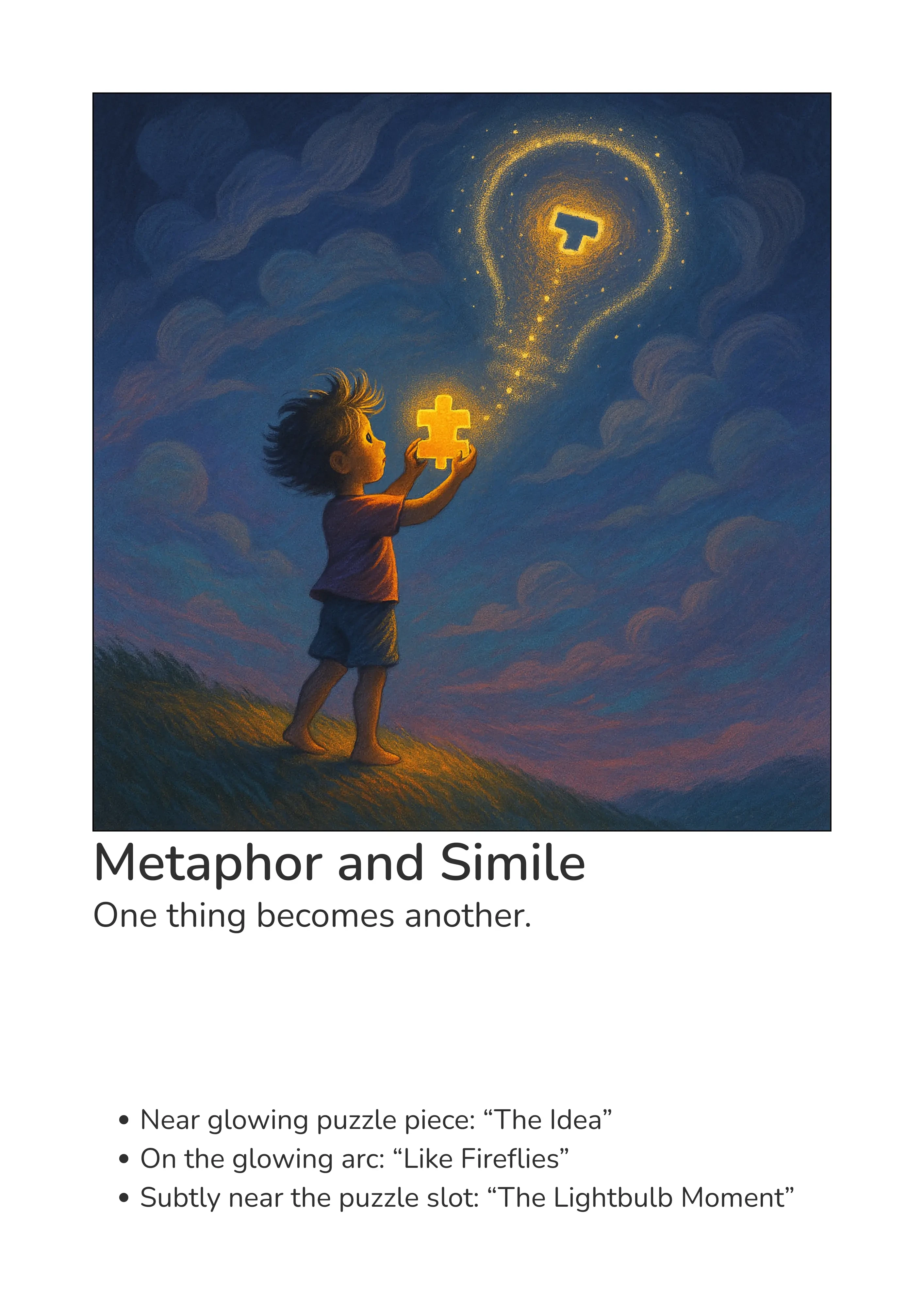
PrimoCard™
The primary conceptual stimulus of Phase IX.
Each card presents a conceptual encounter drawn from the developmental domains of this phase: civic structures, environmental systems, media interpretation, ethical reasoning, and cross-disciplinary abstraction. Cards are designed not to deliver answers but to open structured questions. Every card functions as a reasoning entry point. The learner encounters a concept, an image, a scenario, or a claim, and the guide uses the structured prompt embedded in the material to initiate inquiry.
A reasoning instrument, not a reference object.
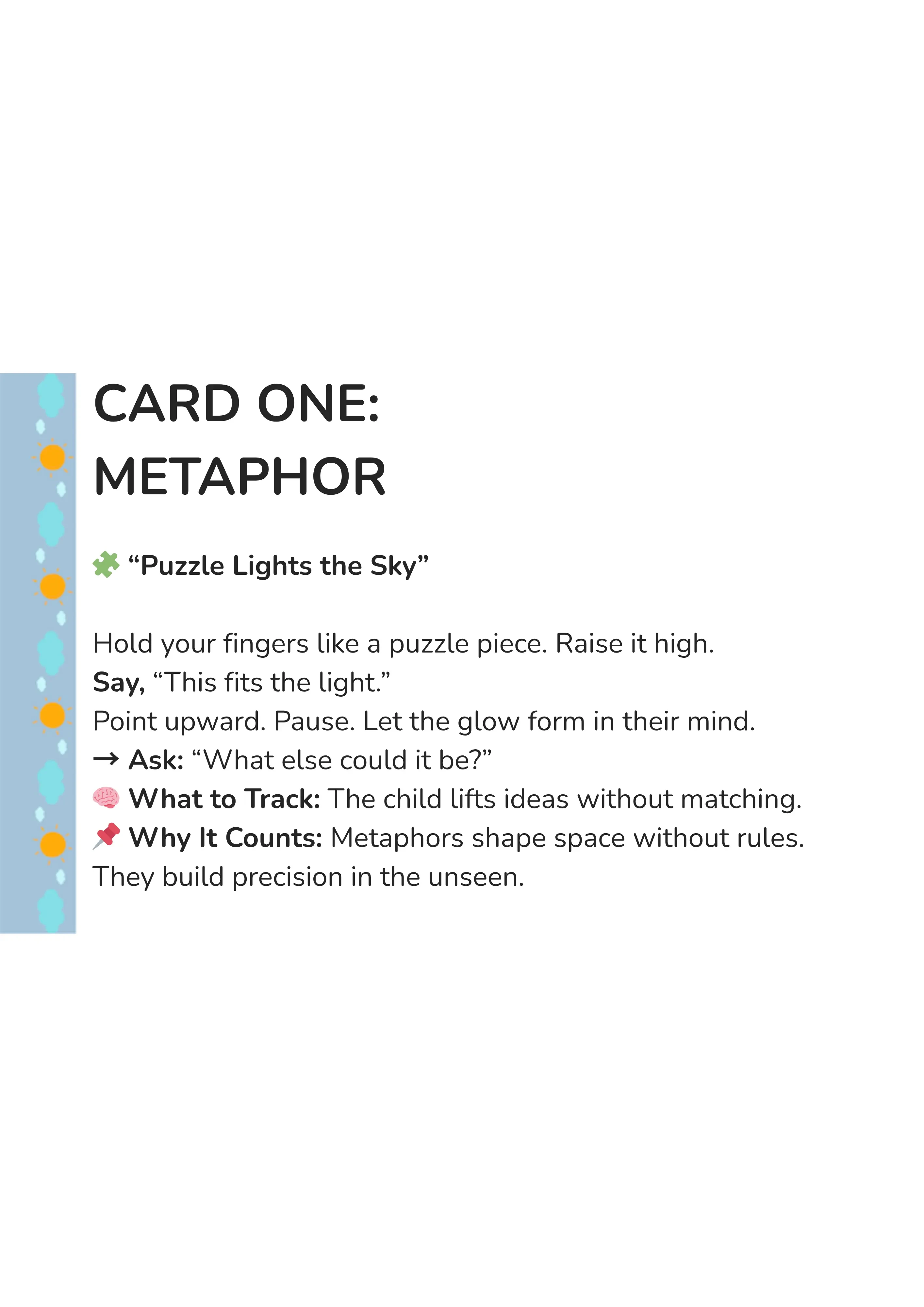
Bright Recall Card™
Structured reasoning support for the guide.
The Bright Recall Card™ provides session references, inquiry anchors, and observation frameworks that allow the guide to engage with each session with intentionality and document what was observed. It is the guide's companion within each interaction, ensuring that the reasoning development visible in one session informs the structure of the next. The card makes each encounter accumulative rather than isolated, building continuity across a phase window that spans three years.
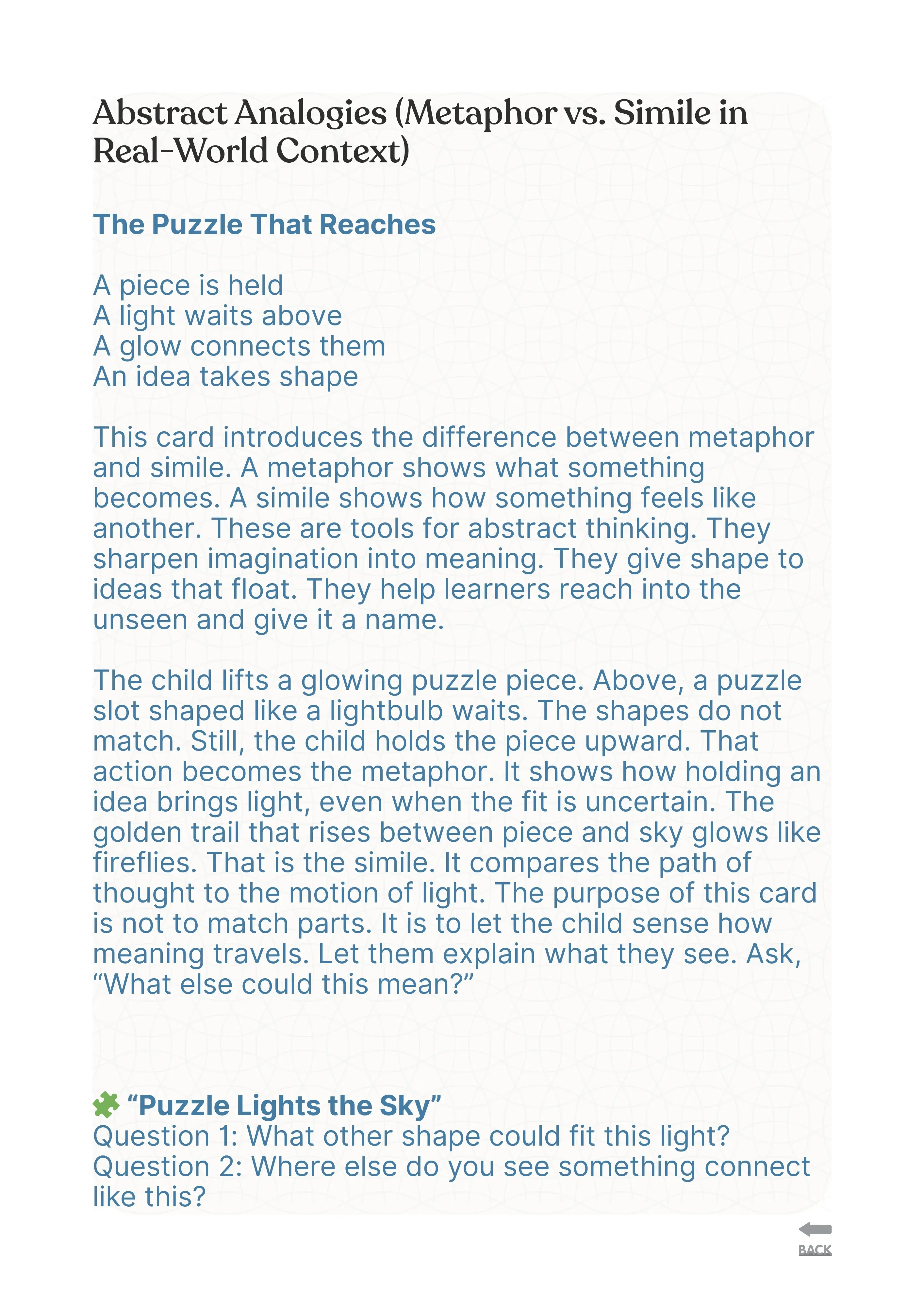
GuideCard™
Direction for structured inquiry practice.
The GuideCard™ provides sequenced instructions for each session within the phase. Which reasoning domain is being entered. How to frame the opening question. When to introduce a counterexample. When to allow the learner to sit with an unresolved position. Each GuideCard™ carries the guide through a defined session structure so that intellectual consistency is built into the practice rather than dependent on the guide's preparation in any given moment.
First Impressions™ Phase Set
The three instruments of Phase IX do not operate in isolation. They function as a coordinated suite, designed to work together across the span of the phase window.

Each card in this set is calibrated to the reasoning demands of the nine-to-twelve developmental window: civic awareness, systems thinking, ethical interpretation, and evidence evaluation. The set delivers the precise intellectual stimulus the developing reasoning apparatus is equipped to receive and engage with at this stage.
The guide's operational reference across the phase. The Guide frames each session within a coherent practice structure, providing the sequencing, pacing, and observational language that turn a moment of conversation into a deliberate act of guided intellectual development.
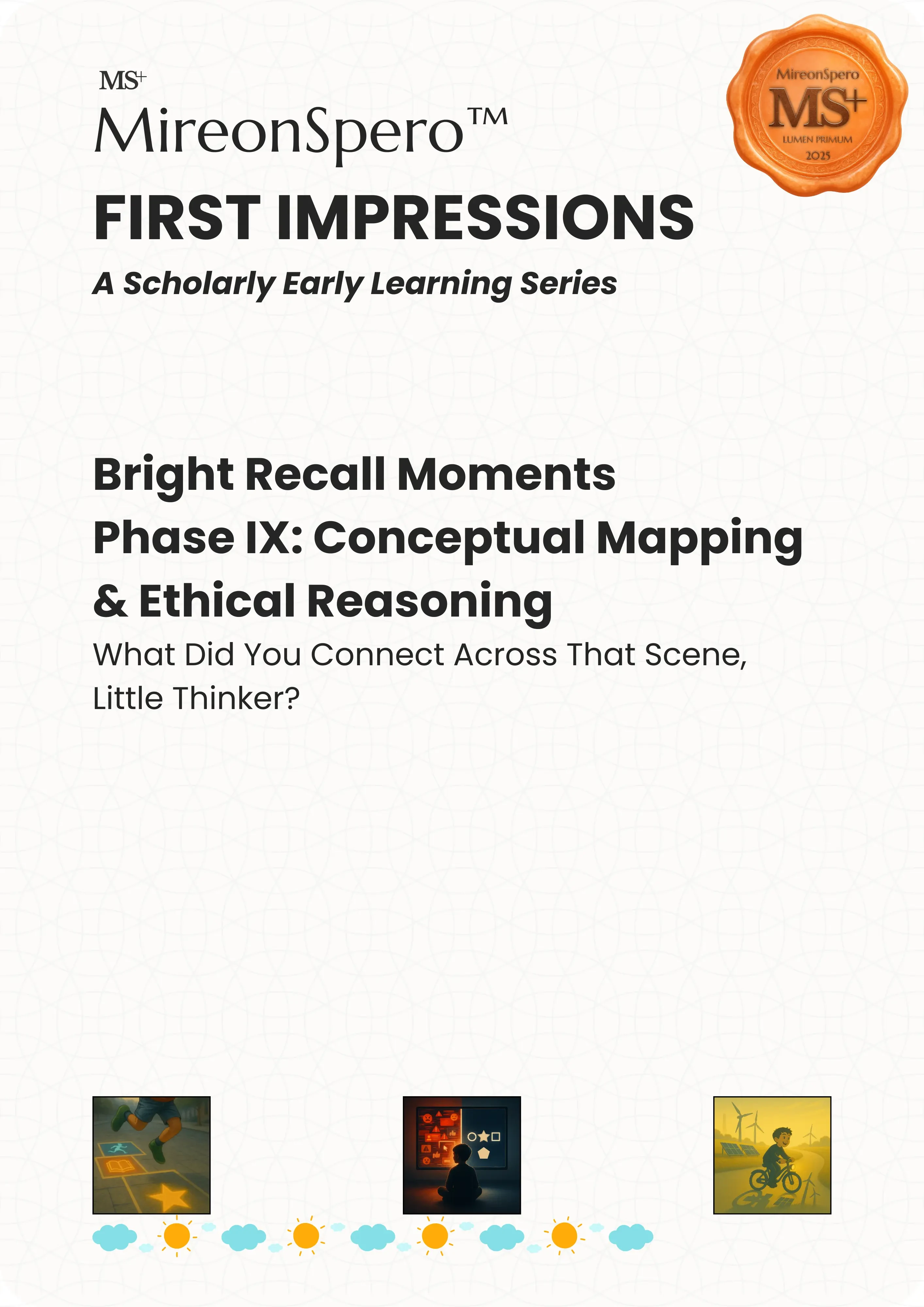
The reflective continuity layer of the phase experience. These materials anchor what was observed, support coherence across sessions, and give the guide a disciplined record of the phase as it unfolds. Each entry builds on the one before it, making reasoning development visible across weeks and months.
Each element has its role. Each role is necessary. The value of the set is in the integration of all three within one coherent architecture of structured intellectual engagement.
The Moment It Changes
There is a particular moment, and every guide who has engaged this phase with seriousness will recognize it precisely, when something becomes visible that was not visible before.
You are sitting with your learner. A question has been posed. Not a question from a test. A real one, drawn from the session material. The learner goes quiet. Not the silence of not knowing. The silence of actually thinking.
Then they begin. Slowly at first. A tentative observation. Then a second one, which connects to the first. Then a third that contradicts the second and causes them to stop, revise, and try again.
You watch the revision happen in real time.
The learner finds the tension in their own reasoning and does not retreat from it. They sit with it. They work through it. They arrive, several minutes later, at a position that is not the one they started with.
This is formal operational reasoning visible at its emergence. What you are observing is a prefrontal capacity consolidating, the ability to evaluate a claim from multiple angles and revise a position in response to internal contradiction.
What you feel in that moment is something different from approval.
What you feel is recognition.
The learner is there. Present in the reasoning, not above it. Constructing a thought rather than retrieving one. The doubt that kept company with you in the earlier months of this phase does not vanish entirely. But it loses its authority.
The Rhythm of Structured Inquiry
Something changes in the weeks that follow a practice-based Phase IX.
The conversations have a different shape now. Dinner becomes a natural extension of the session material. The learner raises a question without being prompted. An article in the news connects to something from the civic reasoning sequence, and the learner names the connection before the guide does. This is not performance. It is a mind that has developed the habit of looking for relationship between ideas.
The guide begins to notice things that would not have been visible before. The learner challenges an assertion in a book without being asked to. They ask about the source of a claim before accepting it. They describe a system, tracing how one variable influences another, with a vocabulary that did not exist in them three months prior.
These observations are not measured for outcome. They are evidence of a reasoning architecture taking form.
The evenings carry a different quality now. The question of whether the sessions are adding something is no longer the central one. The guide knows what the phase is building, because they can see it emerging in the texture of ordinary conversation.
This is what structure gives to a guide who was already paying attention.
The structure gives the attention an architecture. A direction. A system worthy of the intellectual development it is accompanying.

The Nine-to-Twelve Years in Full
Why This Window Is What It Is
The nine-to-twelve developmental window is not simply a period of continued learning.
It is the period in which the capacity for formal reasoning undergoes its foundational organization. Researchers describe this stage as the transition into formal operations: the point at which the mind becomes structurally capable of reasoning about possibilities, not only actualities. The learner begins to evaluate hypotheticals, construct multi-step arguments, and trace consequences across connected systems.
Developmental science identifies this window as one in which intellectual habits are forming with particular durability. A learner who develops the habit of evidence-based reasoning in this period carries a cognitive orientation that tends to persist and deepen. A learner who spends this window rehearsing recall in place of reasoning develops an orientation that is considerably harder to revise at a later stage.
The window does not predetermine outcomes. But it shapes the conditions within which later academic and civic reasoning will operate.
Both guides are present with their learners. Both bring care and attentiveness to the relationship. Only one brings a structured inquiry framework designed for the specific reasoning demands of this developmental window.

Phase IX Within the Full MireonSpero™ Architecture
PrimoFundus™ is the ninth phase of ten. The system does not ask the guide to commit to all ten phases at the outset. Each phase is a complete, self-contained unit within its developmental window. Phase IX is sufficient and purposeful on its own. What follows is governed by where the learner grows.
The ten-phase architecture exists because cognitive development does not conclude at twelve. It continues through the ethical and systems-level reasoning of Phase X, where the learner moves from structured inquiry into moral synthesis and global consequence awareness. The final phase does not introduce new intellectual capacity. It trains the capacity already formed in Phase IX to operate at the level of complex, real-world ethical decision-making.
MireonSpero™ was designed to accompany that entire span, not by defining it or guaranteeing its shape, but by providing a structured, evidence-informed framework for the guide at every stage.
The journey that concludes in Phase X begins, in this phase, with a question. A nine-year-old sitting across from a guide who asks not "what does the text say?" but "what does the text mean, and how do you know?" That question is the architecture of Phase IX made audible.
It begins with inquiry.
What This Is, and What It Is Not
PrimoFundus™ will not produce a philosopher.
It will not advance a learner beyond the parameters of their individual developmental trajectory. It will not guarantee that structured inquiry produces civic eloquence or scientific precision on any defined schedule. It will not remove the uncertainty that belongs to the natural variability of human development.
It will give the guide something more reliable than certainty.
It will give a framework for questioning in the weeks when questioning feels formless. It will give a structure for inquiry when the conversation threatens to circle without direction. It will give the observational language to watch a learner's reasoning develop with something sharper than hope.
It will give the guide the particular confidence that comes from knowing. Knowing what kind of intellectual environment is being provided. Knowing why the structure of a session is organized as it is. Knowing that the question asked three weeks ago and the question asked today are part of a designed sequence, not a series of individual attempts.
A learner moves through the nine-to-twelve years the same way with or without structured inquiry.
The window produces different thinking when the guide knows how to ask the right question.
For the Guide Who Has Read This Far
You did not arrive here by accident. You arrived here because you are the kind of person who examines what a system actually builds before deciding whether to commit to it. You arrived because you noticed the difference between recall and reasoning in your learner, and you understood that the difference is consequential. You arrived because you have already decided, even if you have not yet named it, that the years between nine and twelve deserve more than accumulated content.
You already know what you are going to do.
Not because a deadline demands it. Not because urgency is being manufactured on this page. Because this is the window. Right now, in the years your learner is living, the reasoning architecture is forming. The intellectual habits are taking shape. The capacity for evidence-based thinking, for systemic awareness, for ethical questioning, is either being organized through structured inquiry or it is forming on its own, without the framework that allows it to develop with precision and rigor.
Both paths are present in every developmental window. Only one carries a designed framework.
Three Ways to Begin
The foundational structure of Phase IX. Observational anchors, evidence-grounded inquiry references, and a documented framework for consistent structured engagement. This is where disciplined reasoning practice begins.
Deepened engagement through sequenced inquiry protocols and fidelity-based progression. Every session is framed. Every reasoning encounter has a structured reference. Intellectual consistency is built into the practice, not dependent on the guide's preparation in any given moment.
The most complete expression of Phase IX. The full governing playbook. Ethical inquiry frameworks. Systems mapping tools. Media literacy protocols. Cross-domain reasoning guides. Long-form reflective tracking across three years. And at its center, the Cognisphere™ Inquiry Playbook: organized by year, by reasoning identity, by inquiry domain, from the first session through the last.
This edition does not do more for the learner. It does more for the guide as the architect of the intellectual environment within which the learner's reasoning is formed. That distinction is the governing purpose of the Legacy Edition.
A Note on the Enrollment Model
MireonSpero™ operates under an academic enrollment structure. Phase IX is a complete developmental unit. Enrollment is a single tuition across the phase duration, organized as an institutional commitment to the full three-year arc of this window. This is not a subscription. It is an enrollment in a phase of the learner's structured academic development, with all the seriousness that the word enrollment implies.
Tuition is final upon enrollment. This is the standard of every serious institution that asks its participants to arrive with full commitment rather than provisional interest. If you have read this narrative completely, you already understand why.
The reasoning capacity forming right now in your learner does not pause for a decision.
The guide has one choice to make.
Not whether to be present for this child. That was decided before this page existed.
Whether to meet this window with the intellectual architecture it deserves.
If the answer is yes, the enrollment is open.
MireonSpero™ First Impressions™ · Official Global Enrollment