

PrimoBridge™
Literacy & Numeracy
Foundations
Before fluency. Before the sentence reads without effort.
There are symbols.
The Symbols Begin to Speak
Before fluency. Before the sentence reads without effort. Before the sum resolves without counting on fingers.
There are symbols.
Letters arranged in sequence. Numbers standing in a row. A clock face with hands that sweep across intervals without announcing their meaning. A coin set beside another coin. These are the objects your child encounters now, daily, in classrooms and kitchen tables and the ordinary passage of an ordinary morning.
They are not yet transparent to the child. They are still things to be decoded, held up against a developing architecture of meaning, cross-referenced against what the child already knows in order to determine what the symbol is asking of them.
This is the moment that the first seven phases have been building toward.
Perception matured. Color differentiated. Vocabulary formed. Scenes decoded. Logic emerged. Sound structured itself into language. All of that developmental work arrives here, at the threshold where the child begins to read the world through its formal symbol systems.
This is the moment when learning becomes legible.
The Gap You Cannot Quite Name
You have watched your child read sentences they understood last week and stumble on the same sentences this week. You have watched them solve an addition problem with confidence in one context and lose it entirely in another. The effort is present. The intention is clear. The movement forward is real.
Yet something does not yet feel settled.
This is the particular uncertainty of the six-to-eight-year window. The developmental ground is not unstable. The child is advancing. What you are sensing is the genuine complexity of this stage: the moment when multiple symbol systems are being learned simultaneously and the child has not yet built the internal architecture that connects them.
Words and numbers and time and value and measurement all arrive in this window as distinct domains.
The child studies each one separately.
The integration is still forming.
You sit across the table from your child as they read a word problem aloud. The reading is accurate. The vocabulary is understood. The arithmetic behind the question is within their grasp. Yet they look at the problem as though the sum of its parts is greater than they can hold at once.
This is not a gap in effort. It is a gap in connection.
The uncertainty you carry is not anxiety without cause. It is the attentiveness of a guide who has been watching closely enough to see that something real is at stake in this transition, and that the transition deserves more than good intentions and repetition.
What Happens When Symbols Begin to Connect
The Architecture of Cross-Domain Symbolic Integration
Between six and eight years of age, the child's developing cognitive architecture undergoes a significant reorganization. This is not a sudden leap. It is a sustained integration of systems that have been developing in parallel across the prior phases.
Research in cognitive development identifies this period as the transition from concrete operational reasoning to the earliest forms of cross-domain abstraction. The child who has been learning language as language and mathematics as mathematics begins to form what developmental scientists describe as relational structures: internal models that allow a symbol in one domain to be interpreted through the logic of another.
Morphological awareness deepens in this window. The child begins to notice that the prefix modifies the root, that the suffix changes the grammatical function, that a single word contains within it a logic of composition. Peer-reviewed research establishes that this structural sensitivity is a foundational predictor of reading comprehension and vocabulary expansion in the middle childhood years.
Arithmetic reasoning in this window is supported not by rote memorization alone but by linguistic framing. Research in numerical cognition demonstrates that quantitative understanding becomes more stable when numbers are embedded within meaningful contexts: story problems, real-world measurement tasks, and symbolic representations that connect quantity to consequence.
This is the biology of first integration.
Symbolic abstraction, the capacity to apply reasoning derived from one symbolic context to problems in another, is the defining cognitive achievement of this phase. What this window requires is a framework that makes the connections visible. Language and number are not separate subjects in the architecture of the developing mind. They are related instruments in a single cognitive system.
The Guide as Architect of Integration
There is a question beneath the uncertainty you carry into this phase.
It is not whether your child is capable. You know they are. You have watched capability assemble itself across years of development, phase by phase, domain by domain.
The question is whether the environment you are providing makes the connections available.
In this phase, the guide's responsibility is not to introduce new information. The child has been introduced to letters, to numbers, to the idea of time and value. The guide's responsibility is to build the architecture through which those domains begin to speak to one another.
The guide who brings deliberate, cross-domain framing to the six-to-eight-year window is doing something categorically different from the guide who drills each subject separately. Both guides care. Both guides are present. Only one is working from a designed system of relational exposure.
Guides who work from designed frameworks do not improvise the integration. They deliver it with continuity. Structured relational exposure is not a technique. It is a designed framework. That is the specific form the guide's role takes in Phase VIII.
Phase VIII: PrimoBridge™
An Institutional Statement of Scholarly Purpose
System Identity and Phase Position
MireonSpero™ First Impressions™ is a structured global learning continuum designed to guide cognitive development from early visual perception through organized abstract reasoning. The system advances through ten defined phases, each corresponding to a distinct developmental window and governed by an internal sequence that reflects the progression of the human mind from sensory encounter to structured thought.
Phase VIII, designated PrimoBridge™, represents the eighth layer of this continuum. It operates within the developmental window of six to eight years, a period characterized by the consolidation of early literacy, the stabilization of arithmetic fluency, and the emergence of cross-domain abstraction: the capacity to apply reasoning structures derived in one symbolic domain to problems encountered in another.
This phase does not seek to accelerate the natural progression of academic development. It seeks to organize the conditions within which cross-domain symbolic integration may be developed with consistency, coherence, and scholarly care.
Scholarly Foundation
The design of PrimoBridge™ draws upon established research across morphological awareness, numerical cognition, temporal and monetary reasoning, and symbolic abstraction.
Research in morphological development establishes that morphological sensitivity in middle childhood is a foundational predictor of reading comprehension and vocabulary expansion, confirming the developmental significance of word structure instruction in this window. Studies on the integration of morphological awareness with reading practice demonstrate sustained gains in lexical access and comprehension depth. Research in numerical cognition identifies the role of linguistically framed arithmetic in stabilizing quantitative reasoning across real-world contexts. Studies in reading comprehension confirm that it advances most reliably when language processing and symbolic interpretation are engaged as coordinated, not isolated, activities.
Three Governing Principles
Symbol systems are presented in relation to one another. Language and number, time and value, story and arithmetic are engaged as coordinated domains within each structured interaction. The guide does not separate what the child's mind is working to connect.
Each session maintains an organizing logic that allows the child to encounter symbolic relationships within a stable, predictable framework. The guide does not shift domains without a relational bridge between them. Coherence is the condition under which integration becomes possible.
Engagement accumulates across the full two-year span of the phase. Each session builds upon what the prior session established. The developmental window is treated as an integrated arc, not a collection of discrete lessons.
The Caregiver as System Operator
PrimoBridge™ is designed for the guide, not for the child in isolation. The materials provide the structured contexts within which symbolic relationships are made visible. The guide provides the consistency and relational framing through which those contexts become developmentally meaningful. The quality of attention brought to each session, the deliberateness of the cross-domain connections drawn, and the continuity maintained across the phase window determine the character of the engagement.
Guides are supported in observing the child's responses within a structured framework of reference points. Shifts in the child's capacity to read within a quantitative context, interpret a word problem without separating its linguistic and arithmetic components, or apply time and value reasoning within a narrative are documented as evidence of developing integration, not as measures of performance. This observational practice serves two purposes. It creates a continuous record of the phase experience. It also develops the guide's perceptual precision, strengthening awareness that will serve both the child and the guide through every subsequent phase of the system.
PrimoBridge™ is an enrichment framework. It is designed to complement attentive caregiving and may be used alongside established educational practices and professional guidance. It is not a therapeutic intervention. It does not replace specialized academic support or formal educational programming. It does not function as a diagnostic instrument.
No assurance is made regarding academic performance, reading fluency, arithmetic mastery, or the pace of cross-domain development. Development remains variable, shaped by the individual profile of the child, the consistency of engagement, and the surrounding educational environment.
The system offers a designed framework. The child brings their own readiness to that framework. These are distinct contributions, and this institution does not conflate them.
Three Editions. One Governing Structure.
Each occupies the same phase window. Each addresses the same developmental period. The distinction between them is one of scope, depth, and operational completeness.
Origin Edition
The foundational architecture of Phase VIII. Symbolic mapping frameworks unify linguistic, numerical, and temporal forms within a coherent observational practice. Story-arithmetic pair grids allow the guide to present language and quantitative reasoning as coordinated, not competing, cognitive activities.
Caregiver cue references provide the language for deliberate, measured relational framing across sessions. This is where principled integration practice begins. Not improvisation supplemented by occasional guidance. Practice. Regular, structured, documented.
Prestige Edition
The Prestige Edition deepens relational engagement through calibrated progression across word logic, arithmetic narrative, time-value connectors, and proportional reasoning. Each session is guided within a fidelity-based framework that maintains integration coherence across the full range of symbolic domains in this phase.
A cognitive reflection journal and parent scaffolding guide support continuity between sessions. Every session has a defined relational purpose. Consistency is built into the practice, not dependent on the guide's capacity to construct integration in the moment.
Legacy Edition
The most complete expression of Phase VIII. The Legacy Edition integrates the full phase playbook with an integrative conceptual matrix, a cross-domain logic builder, a fraction-time integrator, an abstract relationship map, a cause-rule-outcome matrix, a concept transfer workbook, and a reflective learner journal.
The Literanum™ Foundation Playbook
A two-year integrative system organizing symbolic literacy and applied quantitative reasoning across two structured developmental stages. Year one structures symbolic literacy and word architecture reasoning. Year two organizes quantitative reasoning and multi-step applied problem solving within real-world frameworks of time, value, proportion, and measurement.
Every week is structured. Every session has a defined relational purpose. Improvisation is replaced by designed purpose, relational continuity, and the clarity of knowing.
Form in Service of Symbolic Function
PrimoBridge™ is delivered through three primary instruments, each designed to serve a distinct function within the phase's relational architecture.
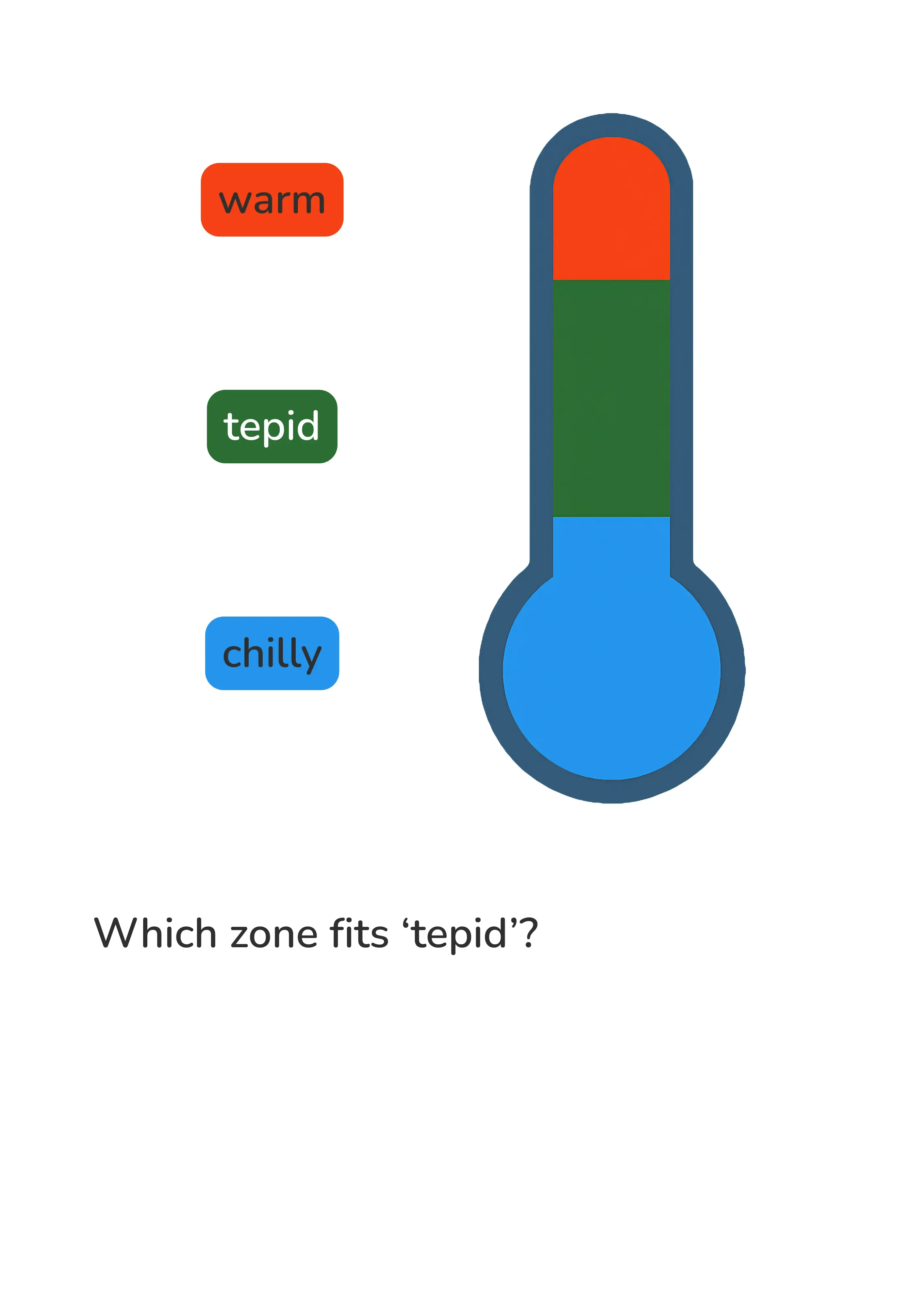
PrimoCard™
The primary relational engagement instrument of Phase VIII.
Each PrimoCard™ in this phase presents a structured cross-domain encounter: a linguistic element paired with a quantitative or temporal context, a morphological pattern placed alongside a numerical relationship, a story frame containing an arithmetic problem that requires both reading comprehension and calculation to resolve. The card does not separate the domains. It presents them in relation, reflecting the integrated cognitive architecture that this developmental window is working to build.
A relational instrument, not a subject-specific drill.
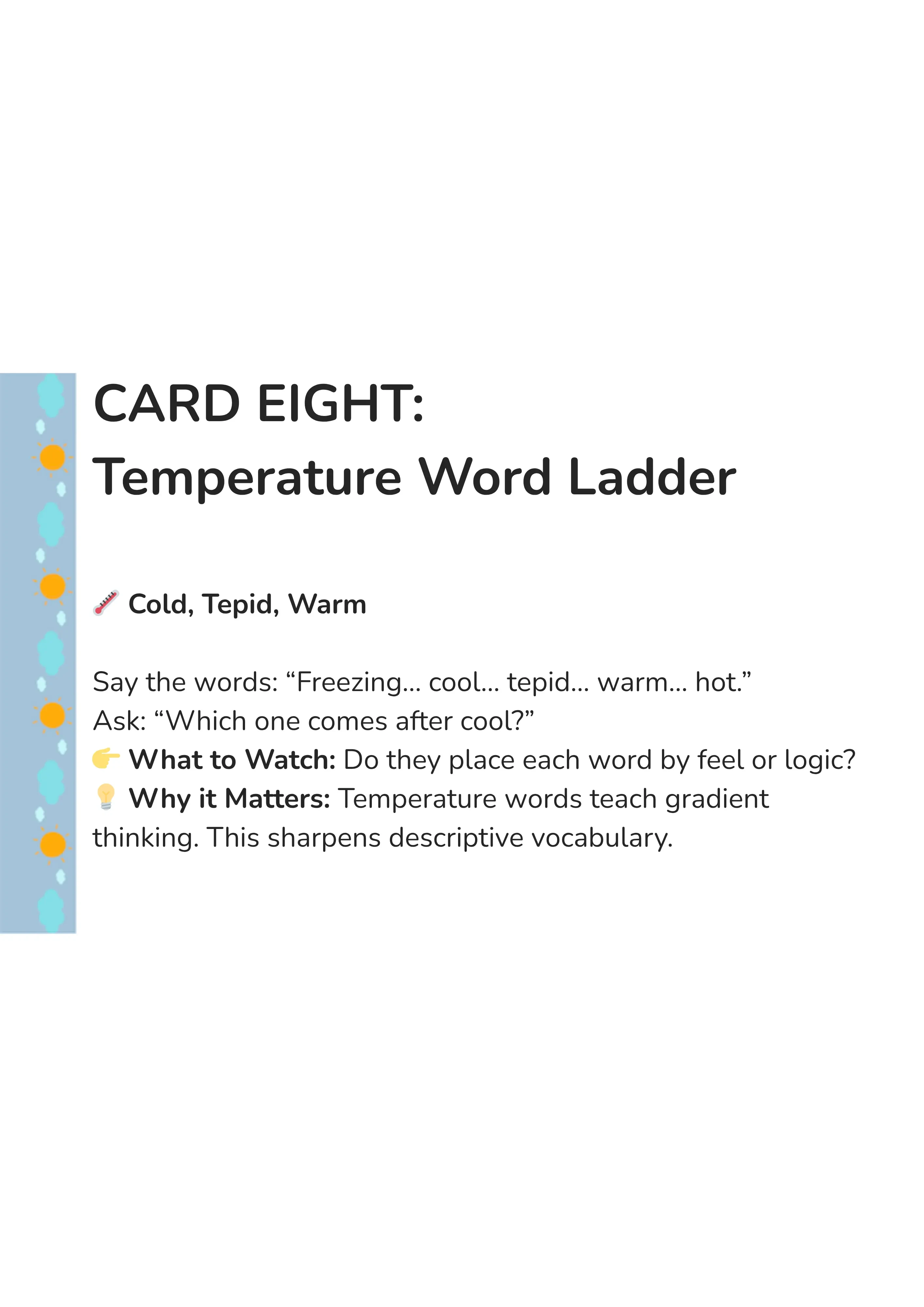
Bright Recall Card™
Structured continuity support for the guide.
The Bright Recall Card™ provides session references, observational anchors, and relational cue frameworks that allow the guide to engage with each session with intention and carry forward what was observed. In a phase where the guide is tracking the child's capacity to integrate language and number simultaneously, continuity of observation is as important as quality of engagement. The Bright Recall Card™ is the instrument through which that continuity is maintained across sessions.
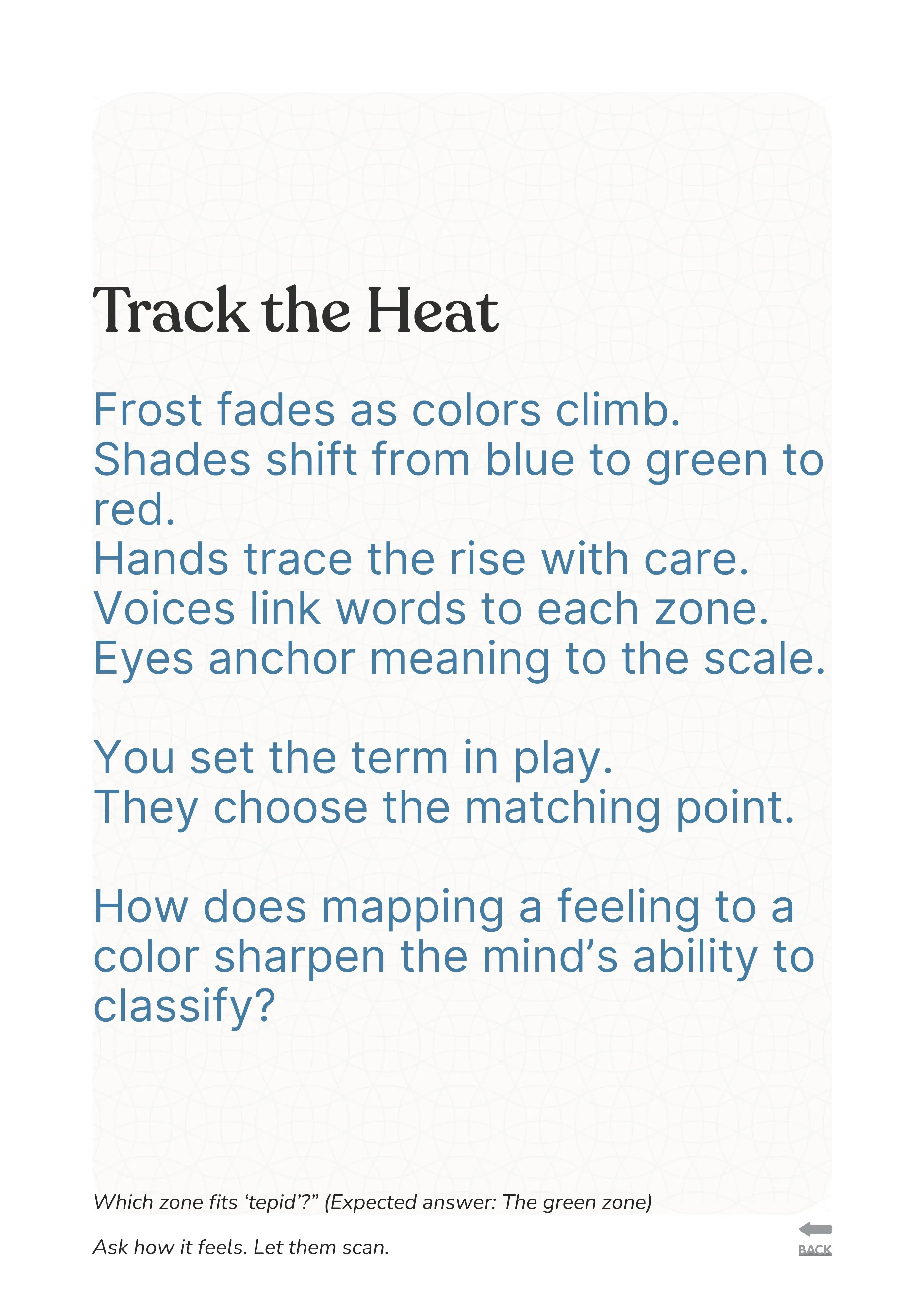
GuideCard™
Direction for deliberate relational practice.
The GuideCard™ provides sequenced instructions for each session within the phase. Which domains are engaged. How the relational connection is introduced. What the observational focus is. When to deepen the cross-domain framing and when to allow the child to resolve the connection independently. Each GuideCard™ carries the guide through a defined session structure so that relational coherence is built into the practice rather than dependent on the guide's capacity to construct integration in the moment.
First Impressions™ Phase Set
The three instruments of Phase VIII do not operate in isolation. They function as a coordinated architecture, designed to work together across the span of the phase window.
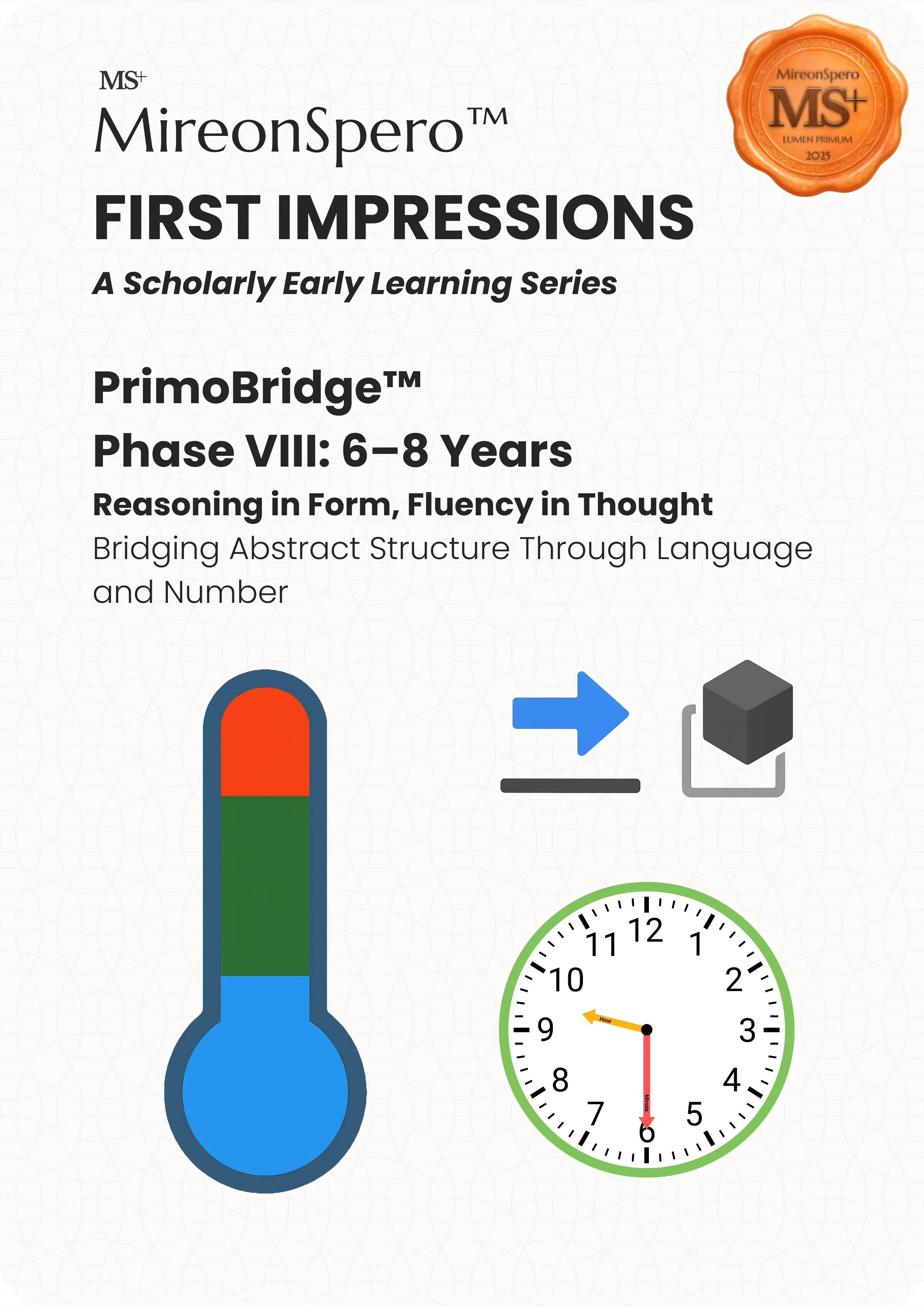
Each card in this set presents symbolic domains in deliberate contact with one another: language nested within quantitative context, morphological structure placed alongside measurement, story framing enclosing arithmetic. The set is a cross-domain encounter system designed for the cognitive moment when language and number are learning to speak to one another.
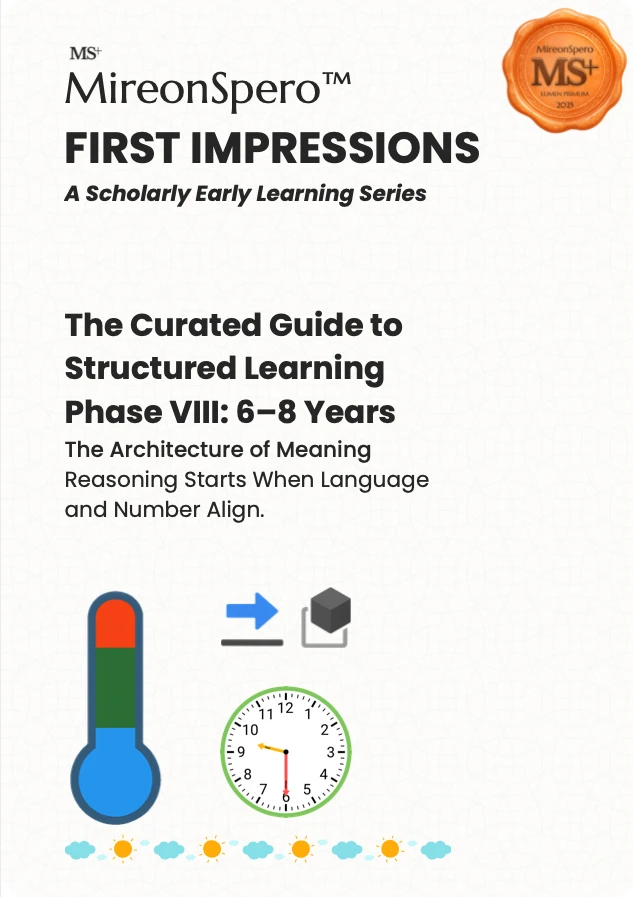
The guide's operational reference across the phase. It frames each session within a relational practice structure, providing the sequencing, pacing, and observational language that transform an act of engagement into a deliberate practice of symbolic integration. Guides who work with this instrument enter each session with a unified relational framework.
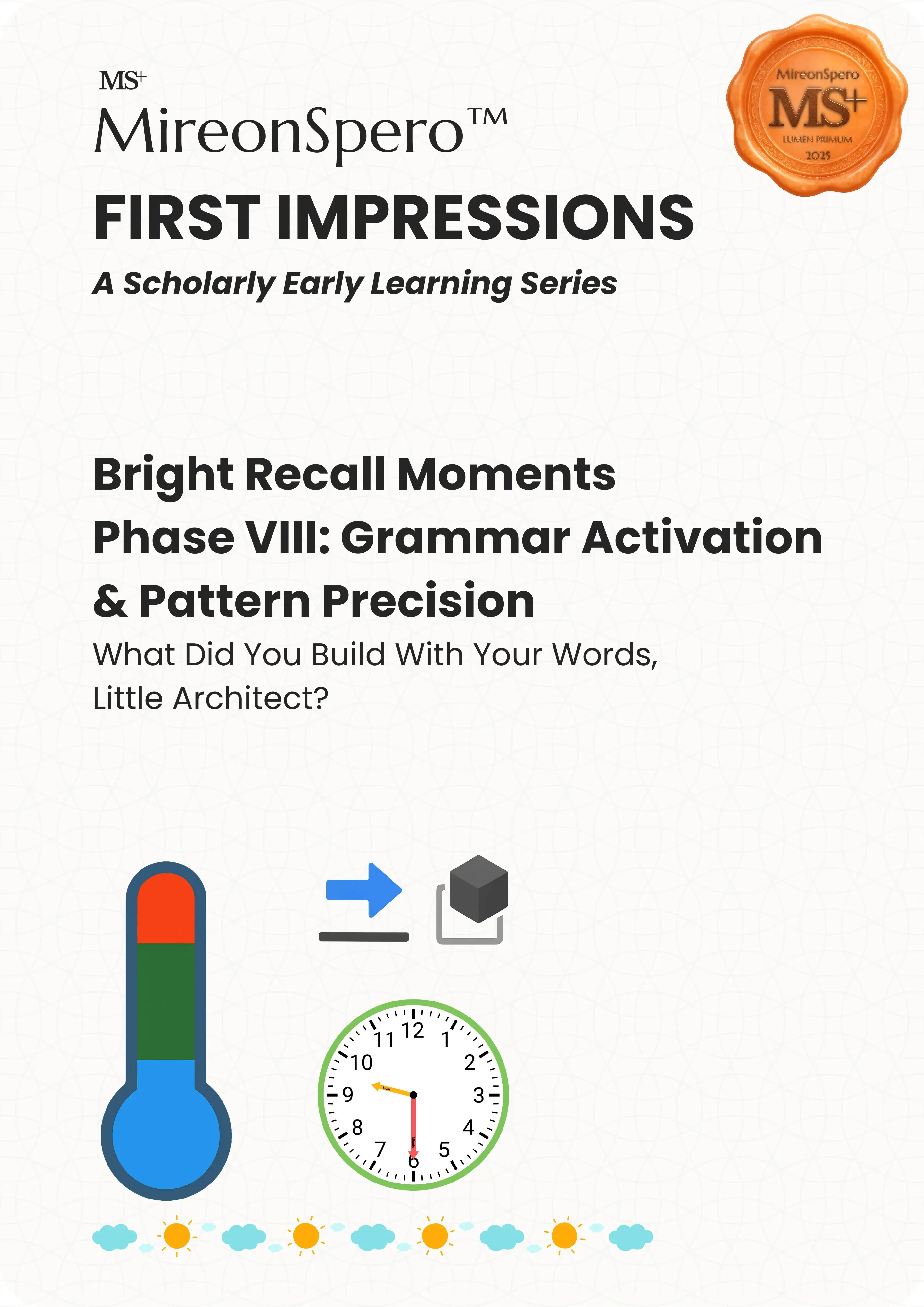
The structured continuity layer of the phase experience. These materials anchor what was observed across sessions, support the guide's capacity to sustain relational framing over the full two-year span, and build a documented record of the phase as it unfolds. They are the mechanism through which practice becomes accumulative, relational, and traceable.
Each element has its role. Each role is necessary. The value of the set is in the relational coherence that all three produce together: a complete symbolic integration environment within every session.
When the Connection Closes
You are sitting beside your child. The session has moved through a story problem: a short narrative about a market, three items, their prices listed in simple whole numbers. Your child has read the paragraph aloud without stumbling. They have identified the relevant quantities. They are now writing the sum.
And then they do something you have not seen them do before.
Without prompting, without looking back at the paragraph, they estimate. They hold the approximate answer in their mind before they calculate the precise one. They compare their estimate to their written sum.
They look at you and say the answer with certainty rather than with a question in their voice.
You feel it before you name it.
What has just happened is the integration of linguistic comprehension and quantitative reasoning within a single act of problem-solving. The child did not treat the story as a reading task and the arithmetic as a separate calculation. They held both simultaneously and moved through the problem as a unified cognitive act.
The structured, relational exposure of the prior sessions was not incidental to this moment. It was the architecture within which the moment could occur.
The doubt loses authority. You have seen the connection form.
The Shape of Integrated Days
Something changes in the weeks that follow a practice-based Phase VIII.
The day carries a different quality of attention. There is a session, a structured encounter with a cross-domain problem, a word problem with a morphological pattern embedded in its vocabulary, a clock-reading task framed within a short narrative, a coin-counting exercise where the arithmetic and the story context are inseparable.
The guide begins to observe things that were present before but now carry meaning. The child pauses over a word in a math problem and applies to it the morphological awareness built in prior phases. The child, reading a recipe, converts fractions into practical measurement without being asked to perform arithmetic. The child estimates before calculating, using the story context to anchor a numerical expectation before verifying it with the written sum.
These are not performances. They are the signs of an integrating cognitive architecture.
The evening carries a different weight now. The question is no longer whether the domains are being addressed. The question becomes which relational connection appeared today, and what the session tomorrow will deepen.
This is what structure gives to a guide who was already attentive.
The structure gives the attention a relational framework. A direction. A designed system worthy of the complexity of what this window is building.

The Six-to-Eight-Year Window in Full
Why This Window Is Irreducible
The six-to-eight-year developmental window is not simply an academic stage. It is the period in which the symbol systems the child has been building separately: language, number, time, and value begin to require one another.
Developmental science describes this as the transition from parallel symbolic learning to relational symbolic reasoning. The child who has learned to read and the child who has learned to count are becoming the child who reads to understand quantities, counts to verify stories, and interprets proportional language as a form of arithmetic. This integration is not guaranteed by time. It is supported by the quality of relational exposure the child receives during the window in which cross-domain abstraction is most receptive to development.
Foundational, in the sense that developmental scientists use the term for this window, means that the relational structures built here support the symbolic reasoning of the middle and later school years. The connections laid down in Phase VIII are the operational architecture through which Phase IX's more complex systemic reasoning becomes possible.
Two guides sit across the table from a six-year-old with a word problem. Both are attentive. Both care. One separates the reading task from the arithmetic. The other frames the problem as a single relational act, holding language and number in deliberate contact throughout the session.
Both approaches are present. Only one builds the cross-domain architecture that this developmental window is structured to support.

Phase VIII Within the Full MireonSpero™ Architecture
PrimoBridge™ is the eighth phase of ten. The system does not ask you to commit to all ten today. Phase VIII is a complete, self-contained unit within its developmental window. It is sufficient and purposeful on its own. You begin here because this is where your child is. What comes after is governed by where your child grows.
The ten-phase architecture exists because cognitive development does not conclude at eight years. The relational symbolic reasoning built in Phase VIII provides the structural foundation for Phase IX's engagement with civic geography, environmental systems, and conceptual literacy across interconnected domains. Phase IX, in turn, prepares the conditions for Phase X's capacity to reason across moral and systemic frameworks, to synthesize ethical positions, and to understand the world as a set of interdependent structures requiring both logic and judgment.
MireonSpero™ was designed to accompany that full span, not by defining its shape or guaranteeing its expression, but by providing a structured, evidence-informed framework for the guide at every stage.
That journey continues here. At a table. With a word problem, a coin, a clock face, and a guide who has decided that the moment when symbols begin to speak to one another deserves more than a subject-by-subject approach.
It begins with connection.
What This Is, and What It Is Not
PrimoBridge™ will not produce a prodigy.
It will not guarantee reading fluency or arithmetic mastery. It will not determine the pace at which cross-domain abstraction develops in any individual child. It will not ensure that every session produces a visible, measurable integration.
It will give you something more useful than certainty.
It will give you a relational framework for the years when language and number are learning to coexist within the same cognitive act. It will give you a structure for observation precise enough to notice when integration begins to appear, and deliberate enough to create the conditions in which it can. It will give you the confidence that comes from knowing that the sessions you are conducting are organized, coherent, and grounded in the developmental logic of this particular window.
The guide who understands that language and number are not separate subjects but related instruments in a single cognitive system brings something to the six-to-eight-year window that attentiveness alone cannot provide. They bring architecture. And architecture is what this window requires.
The six-to-eight-year span passes the same way whether or not the guide holds language and number in deliberate relation.
It is shaped differently when the guide knows how to connect them.
For the Guide Who Has Read This Far
You did not arrive here by accident. You arrived because you understand, even without needing to name it precisely, that something more complex is at stake in this transition: the moment when two symbol systems must begin to speak to one another, and when the quality of relational exposure the child receives shapes the architecture through which later reasoning becomes possible.
You have already made the substantive decision.
The window is open now. The integration that this phase is designed to support is actively developing in your child. The relational structures are forming. The six-to-eight-year developmental receptivity to cross-domain symbolic reasoning belongs to this window. It will not present itself in the same form again.
The guide has one decision to make. Whether to meet that forming with a designed framework or to leave it to subject-by-subject repetition.
The Three Ways to Begin
The foundational structure of Phase VIII. Symbolic mapping frameworks, story-arithmetic pair grids, and caregiver cue references that establish a relational practice for the six-to-eight-year window. This is where principled cross-domain practice begins.
Deepened relational engagement through sequenced word logic, arithmetic narrative, time-value connectors, and proportional reasoning. Every session guided within a fidelity-based framework that maintains integration coherence across the phase. Consistency is built into the practice.
The most complete expression of Phase VIII. The full governing playbook. An integrative conceptual matrix. A cross-domain logic builder. A fraction-time integrator. An abstract relationship map. A cause-rule-outcome matrix. A concept transfer workbook. And at its center, the Literanum™ Foundation Playbook: two years, structured week by week, from the first cross-domain session to the last.
This edition does not do more for your child by definition. It does more for you as the architect of the relational environment through which your child's symbolic integration is guided. That distinction is the entire point.
A Note on the Enrollment Model
MireonSpero™ operates under an academic enrollment structure. Phase VIII is a complete developmental unit. Enrollment is a single tuition across the phase duration, not a recurring subscription, and not a product purchase in the conventional sense.
This structure reflects the nature of what you are entering. You are enrolling in a phase of your child's structured developmental education, with all the seriousness and all the commitment that the word enrollment implies.
Tuition is final upon enrollment. No returns. This is the standard of every serious institution that asks its participants to arrive with full commitment rather than provisional interest. If you have read this narrative completely, you already understand why.
The six-to-eight-year window will not return. The integration that is available in these years, the specific developmental receptivity to cross-domain relational reasoning, belongs to this window. It will not present itself in the same form again.
Each developmental window has its own architecture and its own timeline. The framework is designed to support the guide while that window is active.
The guide has one decision to make. Not whether to care about this child's development. That was decided before this page existed.
Whether to meet this window with the relational architecture it deserves.
If the answer is yes, the enrollment is open.
MireonSpero™ First Impressions™ · Official Global Enrollment