

The First Time Order Appears
Before language arranges itself into sentences. Before numbers line up with purpose. Before the child looks at a set of objects and names what she sees.
There is the reaching.
A small hand moves toward a group of blocks and selects one. Then another. Not at random. With something that looks, to the watching adult, almost like intention. The hand hovers. It places. It adjusts. The child surveys what she has made and moves on, already interested in something else.
The adult stays behind with a question.
Was that counting? Was that sorting? Was that the beginning of a kind of reasoning that has no name yet in the child's mind but is forming, quietly, in the act of selection and arrangement?
This is the developmental terrain of Phase V. It is not dramatic. It does not announce itself. It arrives in ordinary moments at the kitchen table, on the playroom floor, in the middle of an afternoon that feels like no afternoon in particular.
The window has opened. The child is already moving through it.
What the Play Does Not Show You
Between the ages of one and three, the child is in motion. Always in motion. Objects are picked up, carried across rooms, arranged in configurations that mean something to the child and nothing obvious to the observer.
You watch. You narrate what you see. You hold up two fingers and say the word two, and the child watches your hand with that particular quality of attention you have learned to recognize as significant. Then she turns back to the blocks, and you are left wondering whether anything landed.
The doubt that settles here is not the doubt of the early weeks of infancy.
It is more specific than that. It is the doubt of a caregiver who can see something forming but cannot measure it. Symbolic reasoning does not announce its arrival. It builds below the surface of play, in the quiet accumulation of associations between word and object, between gesture and quantity, between the sound of a number and the grouping it represents.
You find yourself watching for signs that may not be visible for months. You ask whether the right words are being used with enough consistency. You wonder whether the arrangement of objects in the environment is helping or whether it is simply neutral, present without function.
Is anything landing?
Am I using the right words?
Is this time, these ordinary afternoons, actually building something?
This is not parental anxiety. This is the correct instinct of a guide who understands that something consequential is happening and wants to meet it with more than goodwill.
That instinct is the beginning of structured practice.
What the Developing Mind Is Building
The Architecture of Early Symbolic Cognition
Between the ages of one and three, a significant transition occurs in the architecture of the child's cognition. The child moves from a world organized by sensory encounter into a world organized by symbolic association.
This transition has a precise character. The child begins to form mental representations of objects and quantities that persist in the mind after the object itself has been removed from sight. A group of three apples, seen and handled, begins to leave a trace in the cognitive system that carries the number three as a concept rather than simply as a visual field. The word and the quantity begin to bind.
Research in early numerical cognition identifies this period as foundational for quantitative reasoning. Research in early numerical cognition establishes that children develop counting principles through consistent verbal and gestural modeling in everyday contexts. The capacity to assign numerical meaning to groups does not emerge spontaneously. It is scaffolded through repeated, structured encounters between language, quantity, and the physical arrangement of objects.
Foundational accounts of symbolic function describe the emergence of representational thought during the second year of life. Social constructivist frameworks extend this by locating the child's symbolic development within the adult-guided interaction space. The adult's language shapes the categories the child is learning to inhabit.
The caregiver's words, gestures, and the structured consistency of the environment function as the scaffolding through which early symbolic reasoning is built.
The child does not construct numerical understanding alone. She constructs it within a relationship in which language is used precisely, repetition is applied with intention, and the sequence of concept introduction reflects the architecture of how the mind learns to count and name.
The Question Behind the Question
When you ask whether your child is grasping numbers, you are not only asking about numbers.
You are asking whether you are teaching with enough precision.
Whether the words you are using are the right words, spoken in the right order, with the right consistency across different days and different routines. You are asking, beneath the surface of the question, whether you know how to be the guide this phase requires.
The guide in Phase V is not a teacher in the formal sense. She does not conduct lessons. She does not administer assessments. She does something more structurally significant. She organizes the symbolic environment through which the child's developing reasoning system encounters quantity, category, and the names that bind them together.
That role requires a specific kind of preparation. Instinct will place blocks in front of a child. Structure will determine how those blocks are presented, how they are named, and how the encounter is designed to support the formation of an association that will persist beyond the session.
Guides use systems. A system provides the vocabulary, the sequence, the pacing, and the observational framework through which structured symbolic engagement becomes possible across the full span of two years.
Phase V is that system, designed for this developmental window and this cognitive transition.
Phase V: PrimoCognia™
An Institutional Statement of Scholarly Purpose
System Identity and Phase Position
MireonSpero™ First Impressions™ is a structured global learning continuum designed to guide cognitive development from early visual perception through organized abstract reasoning. The system advances through ten defined phases, each corresponding to a distinct developmental window governed by an internal sequence that reflects the progression of the human mind from sensory encounter to structured thought.
Phase V, designated PrimoCognia™, represents the symbolic layer of this continuum. It operates within the developmental window of one to three years, a period characterized by the emergence of representational thought, the onset of early numerical cognition, the formation of categorical language, and the child's first sustained engagement with symbolic association between word, object, and quantity.
This phase does not seek to accelerate symbolic development beyond the parameters of the child's individual cognitive trajectory. It seeks to organize the conditions within which that development unfolds, providing the caregiver with a structured framework for consistent, evidence-informed engagement across the full span of the phase.
Scholarly Foundation
The design of PrimoCognia™ draws upon established findings in developmental psychology, early numerical cognition, and the science of symbolic representation.
Research on counting principles identifies the conditions under which early number sense is consolidated, emphasizing the role of consistent verbal modeling and structured gestural practice in supporting quantitative reasoning. Foundational accounts of symbolic function situate the emergence of representational thought within the second year of life. Social constructivist frameworks establish the adult's linguistic modeling as the primary scaffold through which categorical and symbolic understanding develops within shared interaction. Research on core knowledge systems identifies an innate numerical sensitivity in infants that is shaped and refined through structured environmental input during the toddler years.
Three Governing Principles
Words are used consistently across contexts, caregivers, and sessions. The vocabulary of quantity, category, and relation is introduced in a defined order and repeated within structured routines. Language is the primary instrument through which symbolic understanding is built.
Symbolic concepts are encountered within familiar, recurring scenes. Numbers appear in the routine of setting a table. Categories emerge in the act of sorting objects. The concept is always held inside an experience the child already inhabits, not presented as an abstraction separate from daily life.
Each concept prepares the conditions for the next. Object grouping precedes counting. Counting precedes comparison. Comparison precedes the earliest forms of relational reasoning. The sequence is not arbitrary. It reflects the architecture of how symbolic thought builds.
The Caregiver as System Operator
PrimoCognia™ is designed for the caregiver, not for the child in isolation. The materials provide the structured symbolic content. The caregiver provides the relationship through which that content becomes developmentally meaningful. The quality of language, the consistency of naming, and the attentiveness of the observation brought to each session determine the character of the engagement.
Caregivers are guided to observe the child's responses within a structured framework of reference points. The emergence of spontaneous counting, the recognition of matching attributes, and the pairing of a verbal label with a quantity serve as the observational anchors of Phase V. They are recorded not as measures of performance but as evidence of a symbolic system forming within the context of guided interaction. This observational practice trains the caregiver's perceptual awareness and creates a continuous record of the phase experience as it unfolds.
PrimoCognia™ is an enrichment framework. It is designed to complement attentive caregiving and may be used alongside established pediatric and educational guidance. It is not a therapeutic intervention. It does not replace professional developmental evaluation. It does not function as a diagnostic instrument.
No assurance is made regarding developmental progression, numerical mastery, or the pace of symbolic reasoning formation. Development remains variable, shaped by the individual profile of the child and the environment in which the child is held.
The system offers a designed framework. The child brings their own readiness to that framework. These are not the same thing, and this institution does not conflate them.
Three Editions. One Governing Structure.
Each occupies the same phase window. Each addresses the same developmental period. The distinction between them is one of scope, depth, and operational completeness.
Origin Edition
The foundational architecture of Phase V. Observational anchors give the caregiver a reference system for daily practice. Evidence-grounded cue frameworks provide language for what is being observed and why it carries developmental significance. Documentation instruments create a structured record of the symbolic development unfolding across the phase window.
This is where intentional practice begins. Guided exposure to quantity language, categorical naming, and structured grouping, organized within consistent daily routines.
Prestige Edition
Structured advancement through sequenced symbolic pathways, comparative reasoning protocols, and language-embedding frameworks calibrated to the child's developmental progression across the full two-year window. Each session operates within a defined framework designed to support precision and consistency.
The caregiver is guided not only in what language to use, but in how to embed it within the child's daily environment and how to read the child's responses within an organized system of symbolic reference.
Legacy Edition
The most complete expression of Phase V. The Legacy Edition integrates the full governing playbook with a coordinated suite of instructional supports: symbolic environment audit tools, multi-caregiver language alignment guides, a cognitive reflection journal, audio modeling companions for gestural and verbal sequencing, and extended observation frameworks for tracking the emergence of quantitative and categorical reasoning across two years.
The Quantisense™ Discovery Playbook
A two-year sequenced guide to daily symbolic and numerical engagement, organized across three progressive developmental windows within the Phase V span. The first window organizes practice around object grouping, single-word quantifiers, and foundational naming. The second introduces comparative reasoning and proto-sequencing. The third develops relational ordering and early quantity comparison.
The caregiver who enters Phase V with the Playbook does not face the week uncertain about what symbolic experiences to offer. The sequence has been designed. The language has been organized. The practice is defined.
Symbol in Service of Reasoning
PrimoCognia™ is delivered through three primary instruments, each designed to serve a distinct function within the phase.
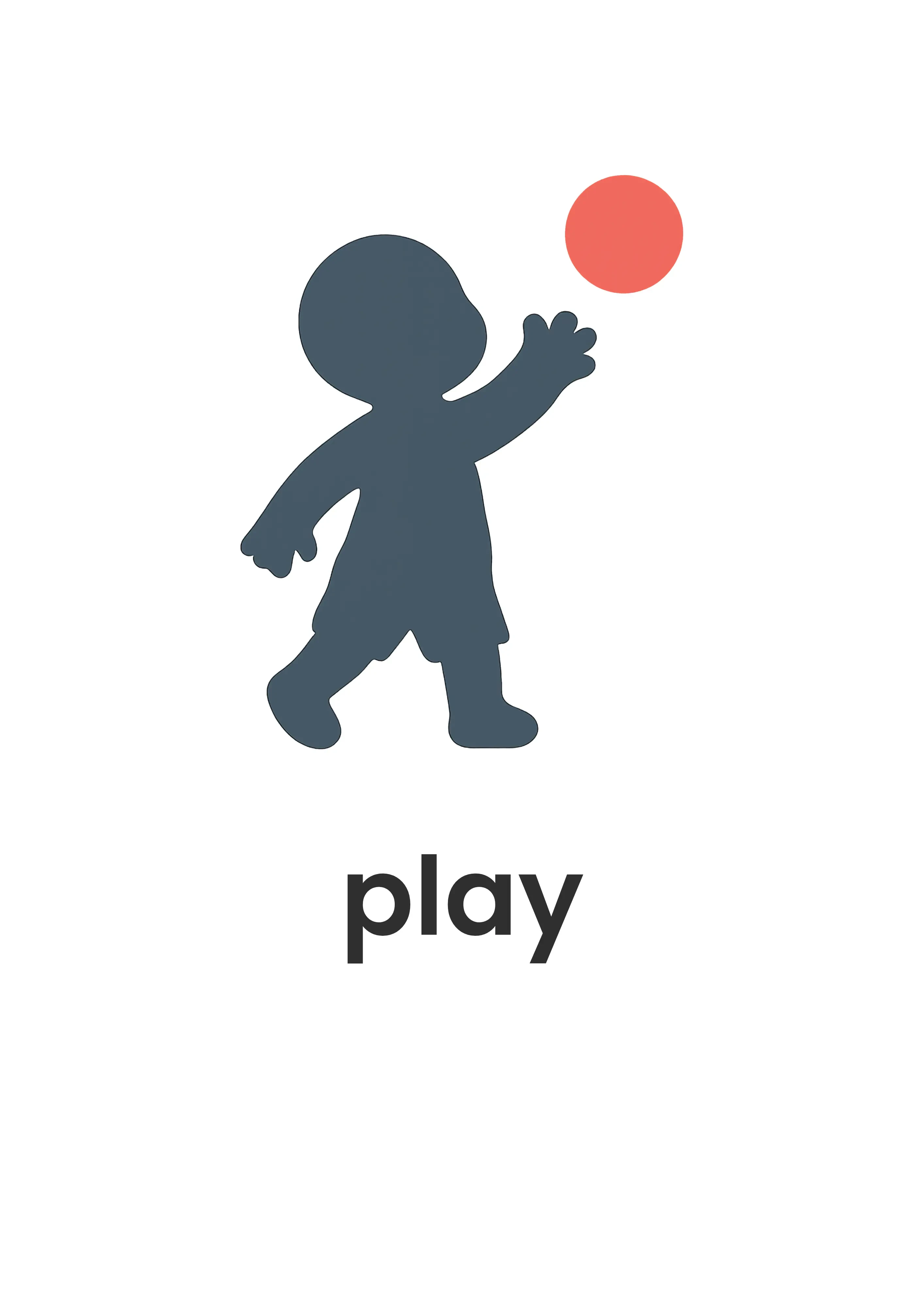
PrimoCard™
The primary symbolic stimulus of Phase V.
Each card is designed to present a single concept with precision. Objects are rendered with clarity and without decorative distraction. Quantities appear in configurations that mirror the real-world arrangements the child encounters in daily life. Categories are visually distinct. The card does not entertain. It presents a symbolic encounter in a form the developing cognitive system is equipped to receive, process, and begin to associate with the language that accompanies it.
A cognitive instrument, not a decorative object.
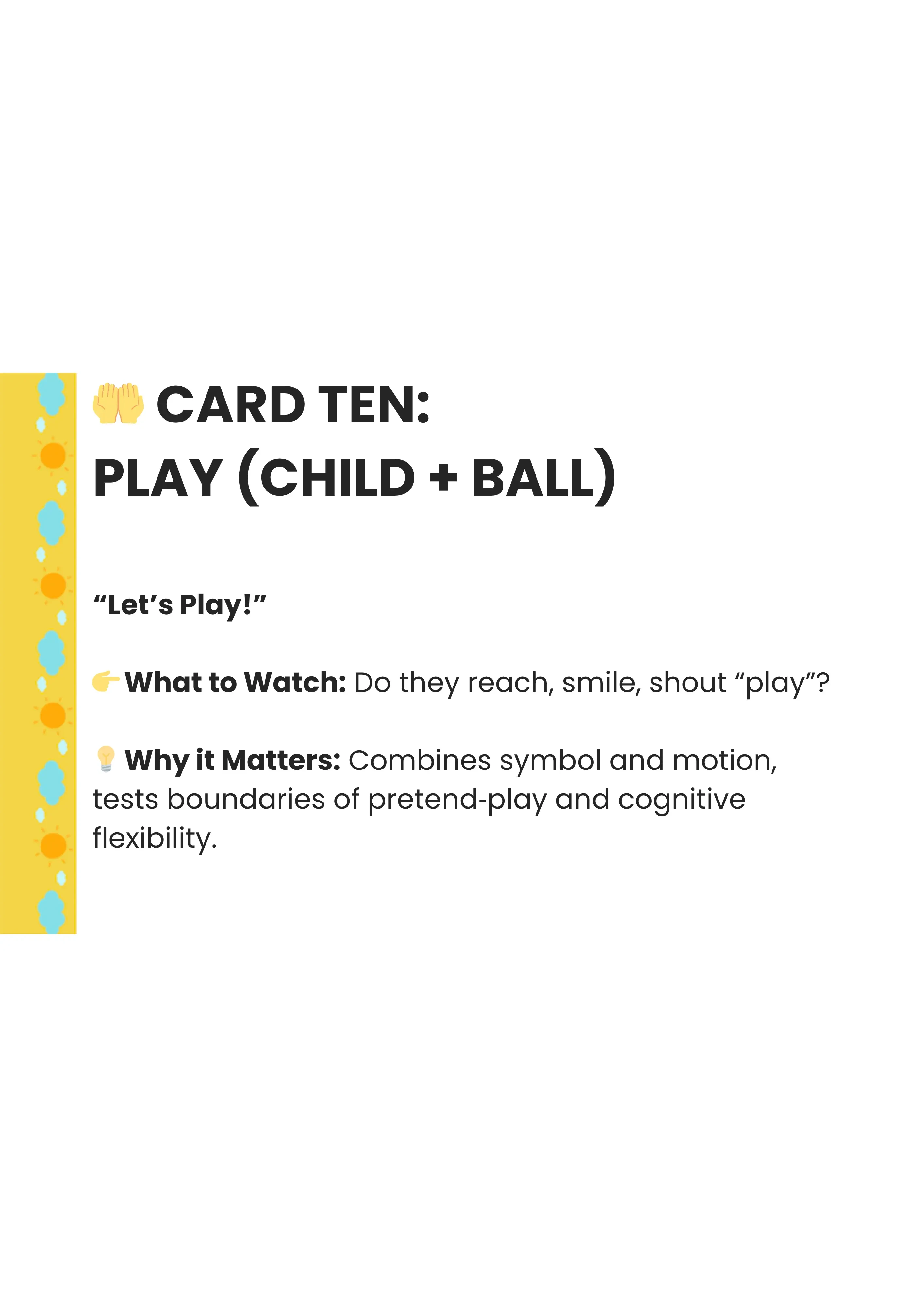
Bright Recall Card™
Structured memory support for the caregiver.
The Bright Recall Card™ provides session references, observational prompts, and language cue frameworks that allow the caregiver to engage with each encounter with intention and retain what was observed across sessions. It carries the caregiver's practice from one interaction to the next without requiring the reconstruction of context from memory. Consistency of language and sequence is built into the instrument, so that the symbolic environment the child inhabits across different caregivers and different days remains coherent.
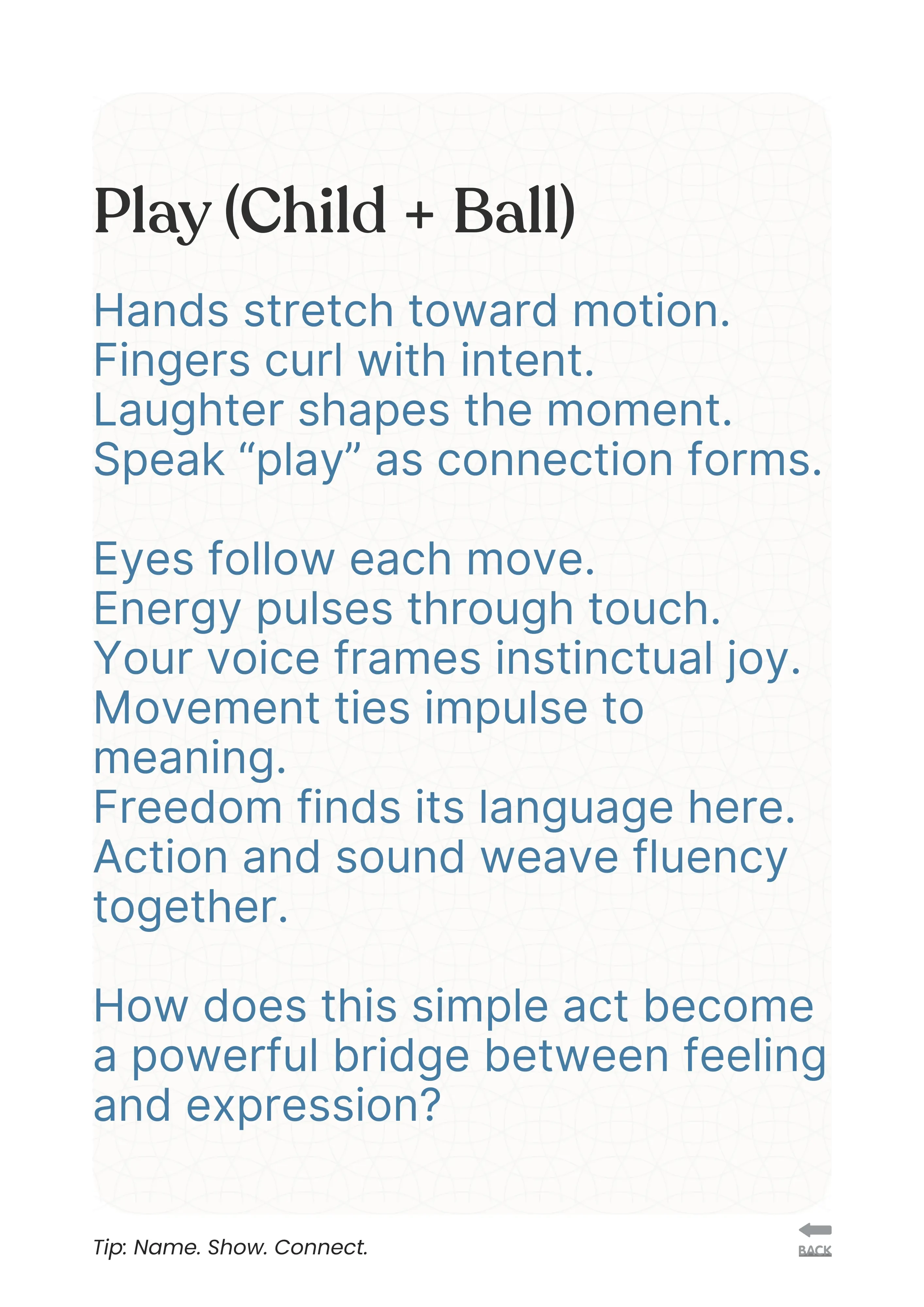
GuideCard™
Direction for deliberate symbolic practice.
The GuideCard™ provides sequenced instructions for each session within the phase. What symbolic content to introduce. How to present a quantity. How to embed a category name within a contextual scene. When to invite the child's participation and when to observe without interrupting. Each GuideCard™ carries the caregiver through a defined session structure so that precision is built into the practice rather than dependent on the caregiver's certainty in any given moment.
PrimoCognia™ Phase Set
The three instruments do not operate in isolation. They function as a coordinated suite, designed to work together across the span of the phase window.
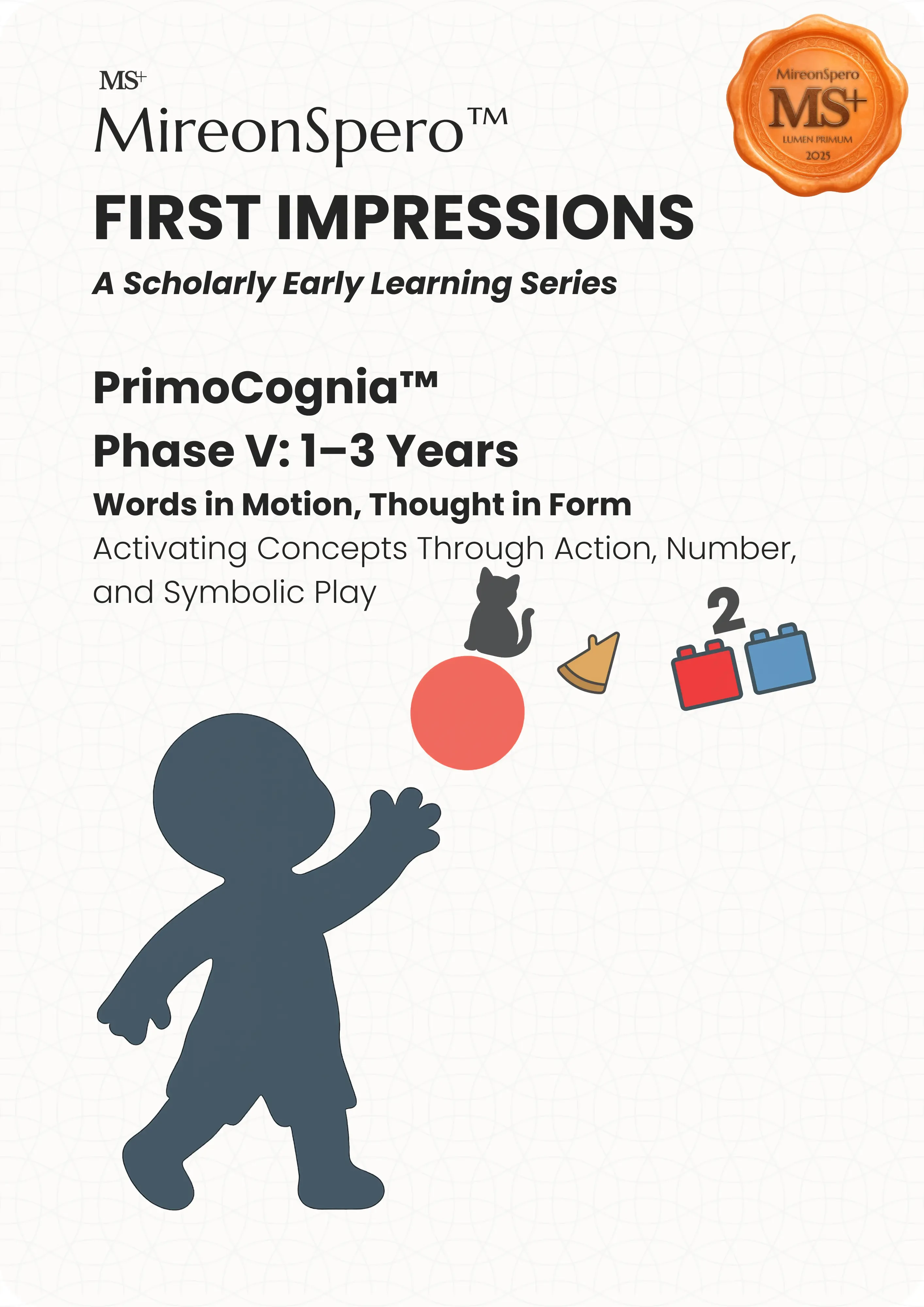
Each card in this set presents a distinct conceptual encounter, whether numerical, categorical, or relational, in a form calibrated to the child's developing representational capacity. The arrangement is not decorative. It is architectural.
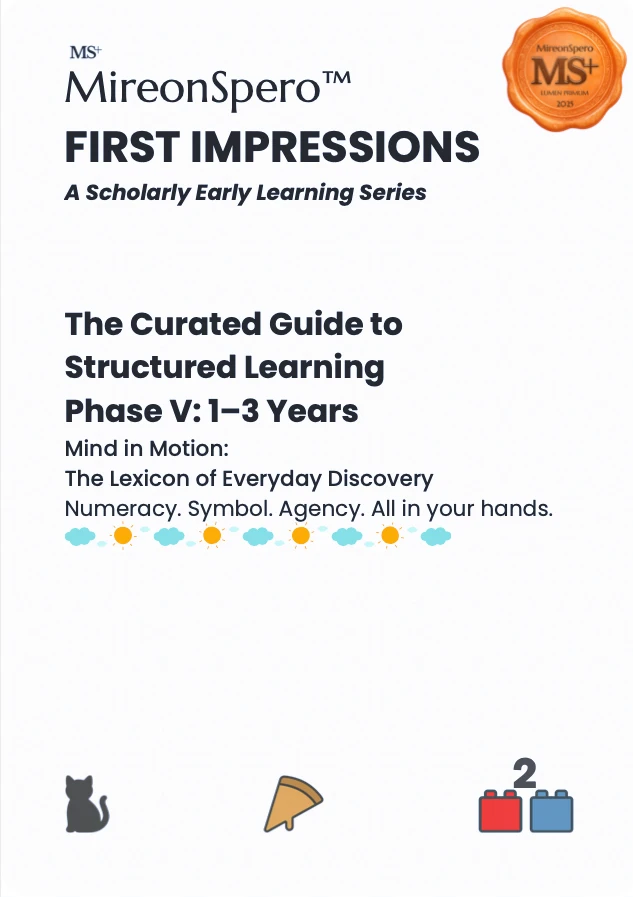
The caregiver's operational reference across the phase. The Guide frames each session within a coherent symbolic practice structure, providing the language scaffolding, the sequencing logic, and the observational orientation that turn a moment of play into a deliberate act of guided conceptual development.
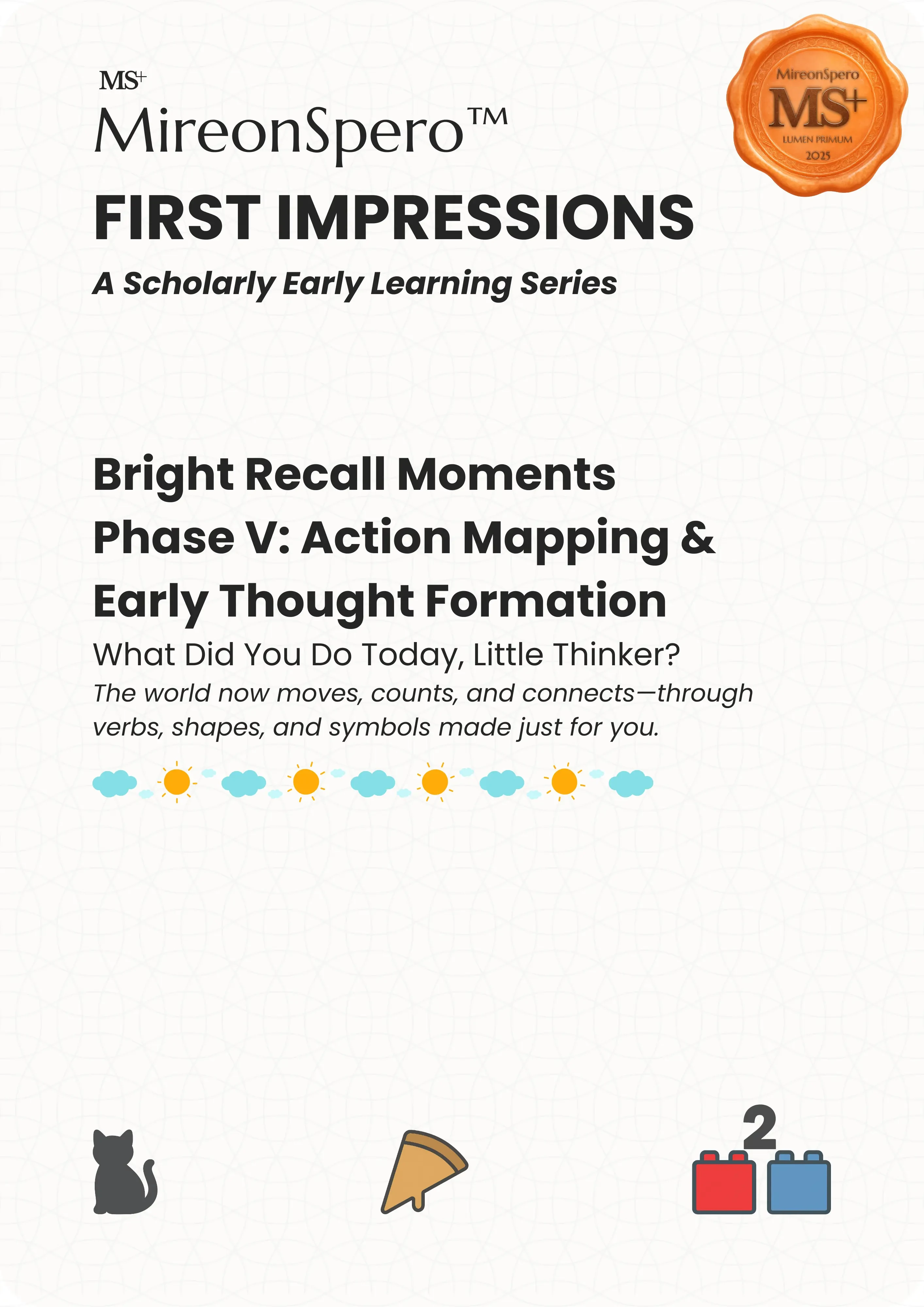
The reflective layer of the phase experience. These materials anchor what was observed, support continuity of language and approach between different caregivers, and give the guide a disciplined record of the symbolic development unfolding across the two-year window.
Each element has its role. Each role is necessary. The value of the set is in the integration of all three within one coherent structure of guided symbolic engagement.
What Happens When Reasoning Becomes Visible
There is a particular moment in Phase V that the caregiver who has been practicing with precision will recognize when it arrives.
You are at the table. There are three small objects arranged in front of the child. You have been using the word three with consistent intention for weeks, always held inside a scene like this one, always accompanied by the same measured gesture, one finger extended for each object in sequence.
The child looks at the objects.
She points. One. Two. Three.
Her voice carries the sequence as something she has built, not something she has heard. The words arrive in order. The pointing follows. And then she looks up at you with an expression that is not quite pride and not quite surprise, but something between them, the expression of a mind that has just discovered it can do something it did not know it could do.
What is happening in that moment is the consolidation of a counting principle. The verbal-numerical correspondence that research identifies as foundational to quantitative reasoning has crossed a threshold. The symbol and the quantity are bound.
You feel it before you can name it. Something has landed. Something that was building beneath the play has become visible.
What you feel is recognition.
The uncertainty of the preceding weeks does not disappear entirely. The developmental path continues. What changes is the evidence. The caregiver has watched a symbolic association form within the structure she provided. She has seen the practice producing something real.
The Days That Carry Symbolic Structure
Something changes in the quality of ordinary days when a structured Phase V practice is in place.
Breakfast has a new register. The spoon moves from bowl to table and the caregiver says one, then two, with the same deliberate pacing she has used since the first week of the phase. The words are not instructions. They are the consistent presence of a symbolic framework inside a familiar routine. The child hears them as part of what breakfast is.
Cleanup is a moment of categorical practice. Objects sorted by color. Objects sorted by size. The caregiver names what she sees as the sorting happens, not as a running commentary but as precise, embedded language that mirrors the conceptual act the child is performing.
This is where language and action align.
You begin to notice things you would not have noticed before. The pause before selection, the survey of the options, the deliberate choice. The small, unhurried signs of a reasoning system developing its own momentum.
The evenings no longer carry the weight of unresolved questions about whether the work of the day added anything. They carry a different kind of awareness. The guide has been practicing with precision. The symbolic environment has been consistent. The observations have been recorded.
Structure gives that care a precise form. A direction. A system worthy of the intention behind it.

Why This Period Warrants a Designed System
The One-to-Three-Year Window in Full
The one-to-three-year window is not an arbitrary boundary in the developmental literature. It corresponds to a specific cognitive transition that researchers across multiple disciplines have identified as foundational for the reasoning that follows it.
During this period, the child's capacity for representational thought undergoes its initial consolidation. The ability to use a word to call an absent object to mind, to assign a number to a quantity, and to group objects by a shared attribute. These capacities emerge within a narrow developmental band and are shaped by the quality of the symbolic environment the child inhabits while they are forming.
Developmental science does not describe this window as a period in which irreversible damage occurs if structure is absent. It describes it as a period of particular cognitive readiness, in which consistent, precise, contextually embedded symbolic exposure produces associations that are stronger, more transferable, and more reliably accessible in later learning contexts than those formed through incidental or inconsistent exposure.
This is why the Phase V window warrants a system rather than an accumulation of good intentions.
Two guides, both attentive, both present, both offering their child language and engagement across these two years. Only one is working within a structured sequence in which the vocabulary of quantity, category, and relation is introduced in the right order, embedded in the right contexts, and observed with a framework that allows the caregiver to see what is forming.
The difference between them is not the quality of their care. It is the architecture of their practice.

Phase V Within the Full MireonSpero™ Architecture
PrimoCognia™ is the fifth phase of ten. The system does not ask you to commit to all ten today. Each phase is a complete, self-contained unit within its developmental window. Phase V is sufficient and purposeful on its own. You begin here because this is where your child is. What comes after is governed by where your child grows.
The ten-phase architecture exists because symbolic reasoning does not conclude at three years of age. It continues through the emergence of causal inference and comparative logic in Phase VI, through phonological awareness and pre-literacy structure in Phase VII, through cross-domain abstraction and academic symbol systems in Phase VIII, and onward through the full arc of cognition toward ethical reasoning and systems-level thinking in Phase X.
MireonSpero™ was designed to accompany that entire span, not by defining its shape or guaranteeing its form, but by providing a structured, evidence-informed framework for the guide at each stage.
That journey extends from this phase forward. It is built on what Phase V establishes: the child's first reliable encounter with the symbolic world, organized within a consistent framework of language, sequence, and guided attention.
It begins with the naming of things.
What This Is, and What It Is Not
PrimoCognia™ will not produce a child who counts before she is ready.
It will not advance her symbolic development beyond her individual cognitive trajectory. It will not guarantee that numbers will be mastered on any particular timeline. It will not give you certainty about what the reasoning she is building today will look like at six or eight or twelve.
It will give you something more durable than certainty.
It will give you a structured vocabulary for the concepts she is forming, delivered with precision at the moments when her developing system is most receptive to them. It will give you the observational language to watch symbolic reasoning take shape with something more specific than hope. It will give you the confidence that comes from knowing that the sequences you are offering, the consistency of the language you are using, and the design of the encounters you are providing are grounded in the science of how representational thought develops.
It will give you a record of this phase. Not a performance record. A developmental record. A structured account of two years in which a mind learned to name what it sees and count what it holds.
The symbolic window passes whether or not the caregiver is practicing with intention.
It forms differently when the practice has been designed.
For the Guide Who Has Read This Far
You did not arrive here by reading a product description. You arrived here because you are the kind of guide who reads carefully through the science of a developmental window before deciding how to engage with it. You arrived because you understand that the one-to-three-year period is not a holding pattern between infancy and preschool. It is the period in which the symbolic architecture of thought is first built. You are not content to leave the construction of that architecture to chance.
You already understand what this phase requires.
Because this is the window. Right now, in the days you are living, the symbolic architecture is forming. The associations between word and quantity are being laid. The earliest categorical distinctions are either being organized through structured engagement or they are forming without it.
Both paths are present in every developmental window. Only one carries a designed framework.
The Three Ways to Begin
The foundational structure of Phase V. Observational anchors, evidence-grounded language cue references, and a documented framework for consistent symbolic engagement within daily routines. This is where principled practice begins.
Deepened engagement through sequenced symbolic pathways, comparative reasoning protocols, and language-embedding frameworks calibrated to the child's developmental progression across the full two-year window. Every session is guided. Consistency is built into the practice.
The most complete expression of Phase V. The full governing playbook. Symbolic environment audit tools. Multi-caregiver language alignment. Cognitive reflection journals. Audio modeling companions. And at its center, the Quantisense™ Discovery Playbook: two years, organized across three progressive developmental windows, from the first act of object grouping to the earliest forms of relational comparison.
This edition does not do more for your child. It does more for you as the instrument through which your child's symbolic reasoning is being organized and guided. That distinction is the entire point.
A Note on the Enrollment Model
MireonSpero™ operates under an academic enrollment structure. Phase V is a complete developmental unit. Enrollment is a single tuition across the phase duration, not a recurring subscription, and not a product purchase in the conventional sense.
This structure reflects the nature of what you are entering. You are not acquiring materials. You are enrolling in a phase of your child's structured developmental education, with all the seriousness and all the commitment that the word enrollment implies.
Tuition is final upon enrollment. No returns. This is the standard of every serious institution that asks its participants to arrive with full commitment rather than provisional interest. If you have read this narrative completely, you already understand why.
The one-to-three-year window will not return. Not in a threatening way. Simply in the ordinary, irreversible way of all developmental time. These months will complete themselves. Each developmental window has its own architecture and its own timeline. The framework is designed to support the guide while that window is active.
The guide has one decision to make.
Not whether to care about this child's development. That was settled long before this page was reached.
Whether to meet this symbolic window with the structured practice it is capable of receiving.
If the answer is yes, the enrollment is open.
MireonSpero™ First Impressions™ · Official Global Enrollment