

PrimoScene™
Words in Motion,
Labels in Life
Before the word is spoken.
There is the scene that carries it.
The Naming of Things
Before words arrive, the world is already full.
A toddler stands at the kitchen window and watches rain gather on the glass. Their hand lifts toward it. Their mouth opens. Something moves through them that has no name yet, but is clearly reaching for one.
This is the moment the developmental literature has been building toward across the first year of life. The perceptual apparatus is calibrated. The neural pathways for sustained attention are laid. The infant who once tracked a high-contrast edge across a white card has become a child who watches rain and wants to tell someone about it.
The reaching is not random. It is the mind's first attempt at a specific, ancient act: connecting what is seen with what can be said.
Language does not arrive as a list. It arrives inside a scene. The word "cup" is not learned in isolation. It is learned at the breakfast table, held by a familiar hand, filled with something warm, surrounded by the sounds and faces of a morning that has its own particular feeling. The scene is the container. The word is what the scene teaches.
This is the developmental architecture of the twelve-to-eighteen-month window.
It is where perception and language make their first sustained contact, not in a controlled environment but in the living rooms and parks and ordinary kitchens where a child's days unfold.
What the Silence Between Attempts Carries
The toddler points. The sound that comes out is close but incomplete. You say the word clearly. They try again. What returns is not quite the word you said, but it is aimed at it.
This moment carries a weight that is difficult to describe to someone who has not sat inside it.
The books describe this window as a period of rapid vocabulary acquisition. They use the phrase language explosion, as if words arrive in a burst and the only task is to be present for it. The lived experience is more complicated. For many guides, the twelve-to-eighteen-month window feels less like an explosion and more like a slow accumulation of attempts, some of which land and many of which dissolve before they reach clarity.
The specific uncertainty of this phase is not whether the child will talk. Most guides understand, abstractly, that language comes in its own time. The uncertainty is subtler.
It is the question of whether the daily interactions are building something coherent, or simply filling time with good intentions.
There is no visible record of what accumulates inside the developing lexicon. The guide gives and gives without confirmation. The feedback loop is slow and unpredictable. A word offered fifty times appears to have no effect, and then on the fifty-first occasion, the child uses it perfectly, without prompting, in an entirely different context.
Is anything accumulating in there?
Are the words I offer building something I cannot yet see?
Is this ordinary time, this unremarkable daily effort, actually doing something?
A guide who feels the weight of this uncertainty is not failing at the task. They are perceiving it accurately. The window is real. The accumulation is real. The structure through which that accumulation is organized is the instrument that gives the uncertainty somewhere to rest.
How the Developing Mind Builds a Word
The Mechanism of Contextual Language Acquisition
Between twelve and eighteen months, the child's cognitive system undergoes a shift that researchers describe as the vocabulary spurt, a period during which word acquisition accelerates markedly. The mechanism behind this acceleration is not mysterious once it is understood.
The infant brain is not learning words. It is learning the principle that things have names. Before this principle is internalized, each new word requires enormous cognitive effort. After it is internalized, the effort drops dramatically, and the child begins to reach for names with genuine urgency.
The developmental process most relevant to this phase is joint attention. When a guide and child orient together toward the same object or scene, the brain registers the word offered in that shared moment with a different quality of encoding than when a word is offered without shared focus. The word arrives embedded in context: the object, the emotional tone of the interaction, the spatial and temporal details of the moment.
This multi-layered encoding is why words learned in lived scenes are retained with greater stability than words learned through isolated exposure.
Research in early lexical development suggests that the rate and durability of vocabulary acquisition in this window may be linked to the quality of guide input. Some studies indicate that children whose guides follow the child's attentional focus and offer labels at the moment of shared gaze may acquire vocabulary more efficiently than children whose guides redirect attention to predetermined objects. Following the child's own interest is generally considered a useful approach to vocabulary encoding.
Emotional cue integration enters the picture in this phase in a way it did not in earlier phases. The child at twelve months is not only decoding the names of objects. They are reading the guide's face, tone, and gesture simultaneously. These combined signals create a conceptual structure around the word that bare auditory exposure cannot produce.
The distinction that matters for practice in this window is the distinction between labeling and narrating. Labeling delivers isolated words to a listening child. Narrating embeds words inside the unfolding logic of a scene, connecting actions and objects and emotional signals into a structured experience that the developing lexicon can organize and retrieve.
The Specific Responsibility of the Guide at This Stage
The guide in the twelve-to-eighteen-month window carries a question beneath the visible one.
The visible question is about vocabulary. Are enough words being offered? Are they being offered correctly? Is the timing right? These questions are answerable, and this phase answers them.
The question beneath the visible one is about coherence.
Whether the daily interactions that fill these months are adding up to something organized, or whether the child is receiving language as a series of disconnected inputs that the child alone must work to arrange into a structure.
A guide in this developmental window is not a vocabulary instructor. The role is more precise. The guide is the architect of the scene within which language is encountered. They shape the emotional tone of the interaction. They follow the child's attentional focus. They offer the label at the moment of shared gaze, in a voice that carries both the word and its emotional context.
Most guides bring love and presence to this window. They talk to their children. They point at things. They read books with enthusiasm. These acts are valuable. They are also insufficient when unstructured, because the mechanism of contextual language acquisition is specific enough that it rewards deliberate practice.
A guide who understands the mechanism behind this window does not rely on the hope that language will find its way. They build the scenes within which language becomes inevitable.
Phase IV: PrimoScene™
An Institutional Statement of Scholarly Purpose
System Identity and Phase Position
MireonSpero™ First Impressions™ is a ten-phase developmental continuum designed to organize the conditions for cognitive formation from early visual perception through applied ethical reasoning. Each phase corresponds to a distinct developmental window and delivers a structured framework for guide-led engagement within that window.
Phase IV, designated PrimoScene™, operates within the developmental window of twelve to eighteen months. This phase addresses the emergence of contextual language acquisition, the consolidation of joint attention as a mechanism for vocabulary encoding, and the integration of emotional cue reading with early lexical development. It is the phase at which the First Impressions™ continuum shifts from primarily sensory and perceptual engagement toward the structured organization of language within lived experience.
This phase does not seek to accelerate vocabulary acquisition beyond the child's individual developmental trajectory. It seeks to organize the conditions within which that acquisition unfolds, providing the guide with a structured framework for consistent, scene-grounded language engagement across the full span of the phase window.
Scholarly Foundation
The design of PrimoScene™ draws upon established findings in developmental linguistics, early cognitive science, and the study of guide-child interaction.
Research on joint attention identifies it as a primary mechanism of early vocabulary acquisition, demonstrating that words offered within a shared attentional frame are encoded with greater stability and specificity than words offered without shared focus. Studies on intentionality and early language confirm that the child at this developmental stage is acquiring not isolated words but the communicative intentions behind them, making the quality of guide interaction more consequential than its volume. Research on contextual language learning establishes that words embedded in familiar scenes and routines are acquired earlier and retained more durably than words introduced in controlled settings. Studies in social-referential word learning demonstrate that children follow the guide's attentional focus as the primary signal for word-to-object mapping. Research on emotional tone in early lexical encoding establishes that the affective quality of the interaction around a word influences both its acquisition and its retention.
Three Governing Principles
Language is offered inside the scenes where it lives. Every word encounter is embedded in its natural context. Decontextualized drilling is not the method of this phase. The scene is not background for the word. The scene is what makes the word legible.
The guide follows the child's gaze and interest before offering the label. Vocabulary is offered at the intersection of the child's focus and the guide's shared presence. Following the child's own interest is generally considered a useful approach to encoding.
The voice carries the word's meaning. A word offered in a calm, warm tone across consistent repetition builds a different internal structure than the same word offered in an inconsistent register. Tonal coherence is a structural condition for stable lexical encoding in this window.
The Guide as System Operator
PrimoScene™ is designed for the guide, not for the child in isolation. The materials provide the scenes and the structural framework. The guide provides the shared attention, the tonal coherence, and the relational presence through which the scene becomes a language-learning event. The quality of the guide's attentional alignment in each session is the variable that determines the quality of the encoding.
Guides are supported in this phase with observational reference points specific to the twelve-to-eighteen-month window. Signs of emerging joint attention, the vocabulary pointing gesture, attempts at word imitation, and early evidence of word-to-scene mapping are documented through structured observation instruments. These observations do not measure performance. They build a continuous record of the phase experience and train the guide's perception to read the child's lexical development with increasing precision.
PrimoScene™ is an enrichment framework. It is designed to complement attentive caregiving and may be used alongside established pediatric guidance and developmental practice. It is not a language intervention. It does not replace speech-language evaluation or professional developmental assessment where such support is warranted.
No assurance is made regarding vocabulary acquisition rate, expressive language outcomes, or the pace of lexical development. Development remains variable, shaped by the individual profile of the child, the consistency of engagement, and the full complexity of the environment in which the child is held.
The system offers an organized framework. The child brings their own readiness and individual developmental trajectory to that framework. These are distinct contributions. This institution does not conflate them.
Three Editions. One Governing Structure.
Each occupies the same phase window. Each addresses the same developmental territory. The distinction between them is one of operational depth, structural completeness, and the precision of guide support provided across the full phase duration.
Origin Edition
The foundational architecture of Phase IV. Scene-grounded vocabulary frameworks, joint attention calibration references, and session documentation instruments organized for consistent daily practice. Observational anchors give the guide a reference system for recognizing and responding to the child's attentional focus with appropriate vocabulary.
This is where deliberate practice begins. Daily interaction transforms from ambient language exposure into organized, scene-embedded vocabulary development.
Prestige Edition
Structured advancement through sequenced scene categories, tonal coherence guides, and fidelity-based progression tracking across the full phase window. The guide is supported in sequencing vocabulary introduction across scene categories: domestic scenes, outdoor environments, social interactions, and emotional contexts.
Each session operates within a defined structure designed to support attentional alignment and emotional coherence across the full span of the phase window.
Legacy Edition
The most complete expression of Phase IV. The Legacy Edition integrates the full governing playbook with a coordinated suite of instructional supports: contextual narrative frameworks, multi-guide alignment tools, emotional tone calibration guides, extended tonal coherence references, and long-form vocabulary emergence tracking instruments.
The LexiMotion™ Integration Playbook
A one-hundred-eighty-day sequenced guide to scene-grounded vocabulary engagement, structured from the opening weeks of the phase through its close. Each week is organized within a progressive scene framework that advances in vocabulary scope and contextual complexity as the child's lexical capacity develops.
The guide who enters Phase IV with the Playbook does not approach each morning as an open-ended question about what to say or when to say it. The scene architecture for each week has been designed. Improvisation is replaced by purposeful structure, informed presence, and the particular confidence that comes from knowing that the language offered today is part of a deliberate sequence.
Form in Service of Language
PrimoScene™ is delivered through three primary instruments, each designed to serve a distinct function within the phase.
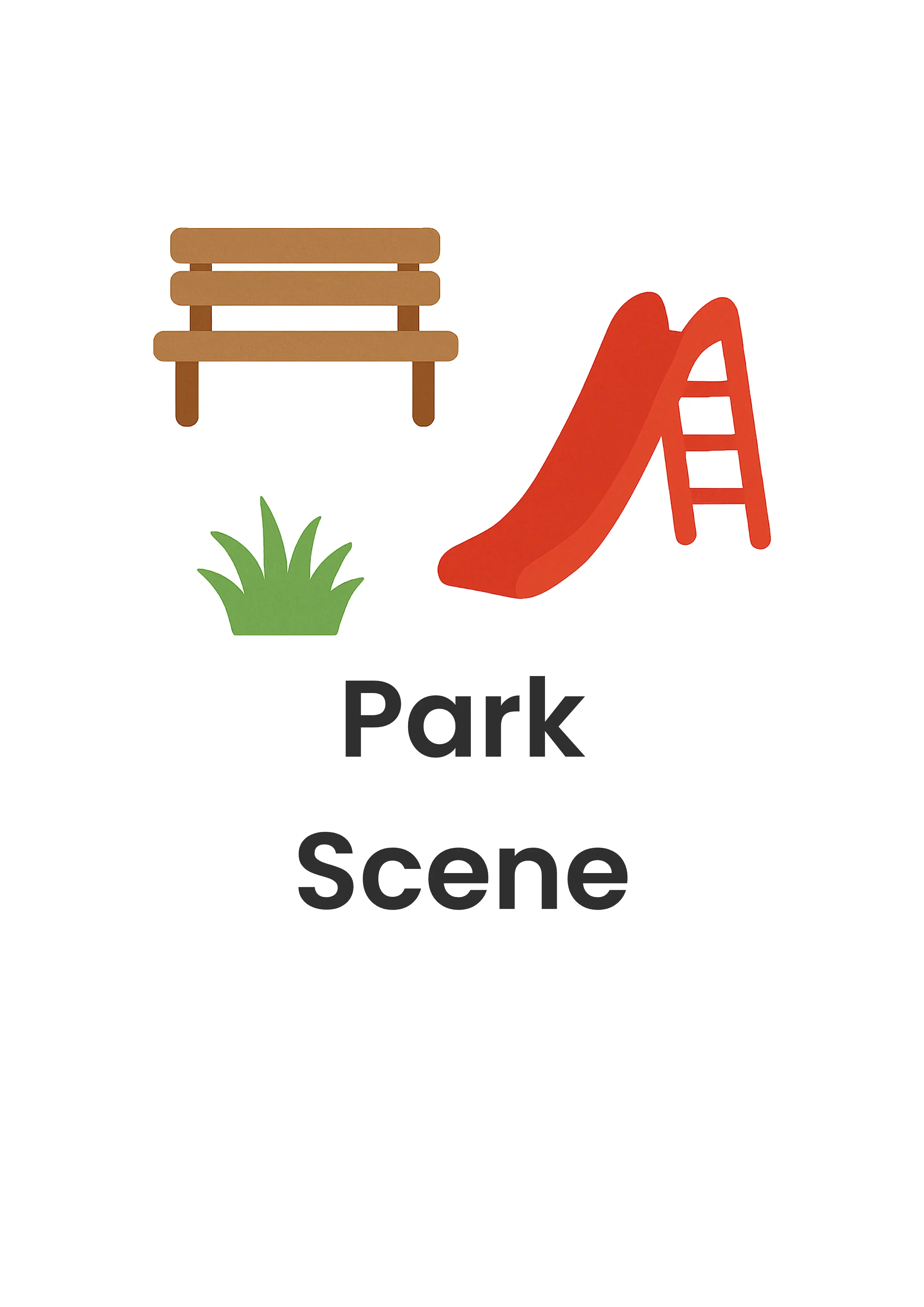
PrimoCard™
The primary scene stimulus of Phase IV.
Each card presents a complete, visually organized scene drawn from the child's lived world. Domestic environments, outdoor spaces, social interactions, and emotional moments are rendered with clarity and intentional detail. The scene contains the vocabulary. The guide's role is to offer that vocabulary within the shared attentional frame the card creates between the adult and child.
The PrimoCard™ is a scene architecture. It constructs a shared moment of attention within which joint-attention-mediated vocabulary encoding can occur.
A scene-based instrument. Not a picture to name but a context for language to enter.
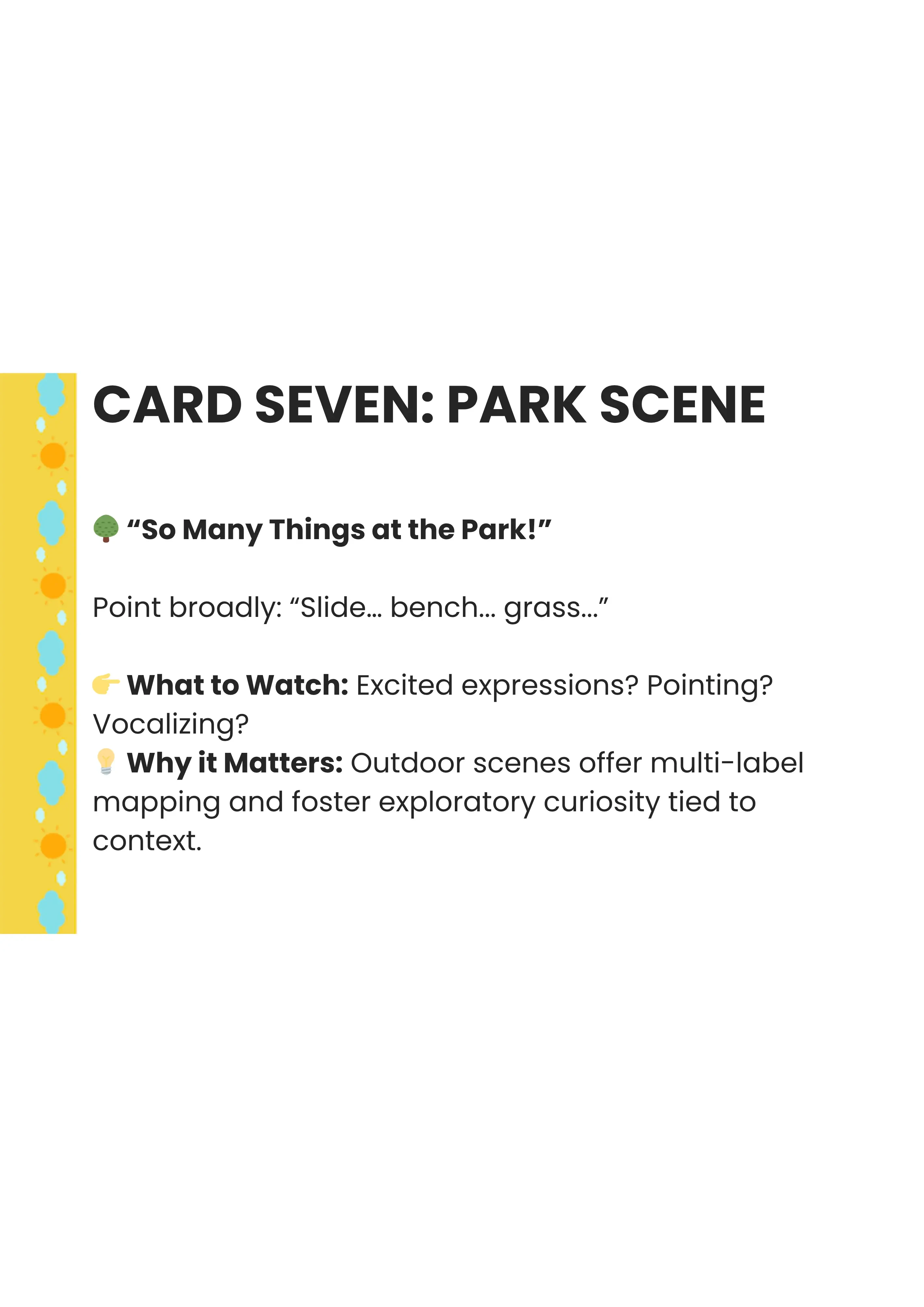
Bright Recall Card™
Structured session support for the guide.
The Bright Recall Card™ provides scene-specific vocabulary references, attentional alignment prompts, and tonal guidance that allow the guide to enter each session with structural clarity. It holds the session's vocabulary priorities and the observational reference points relevant to this particular scene category. The guide who uses the Bright Recall Card™ within a session carries the session's architecture into the interaction, rather than reconstructing it from memory while simultaneously attending to the child.
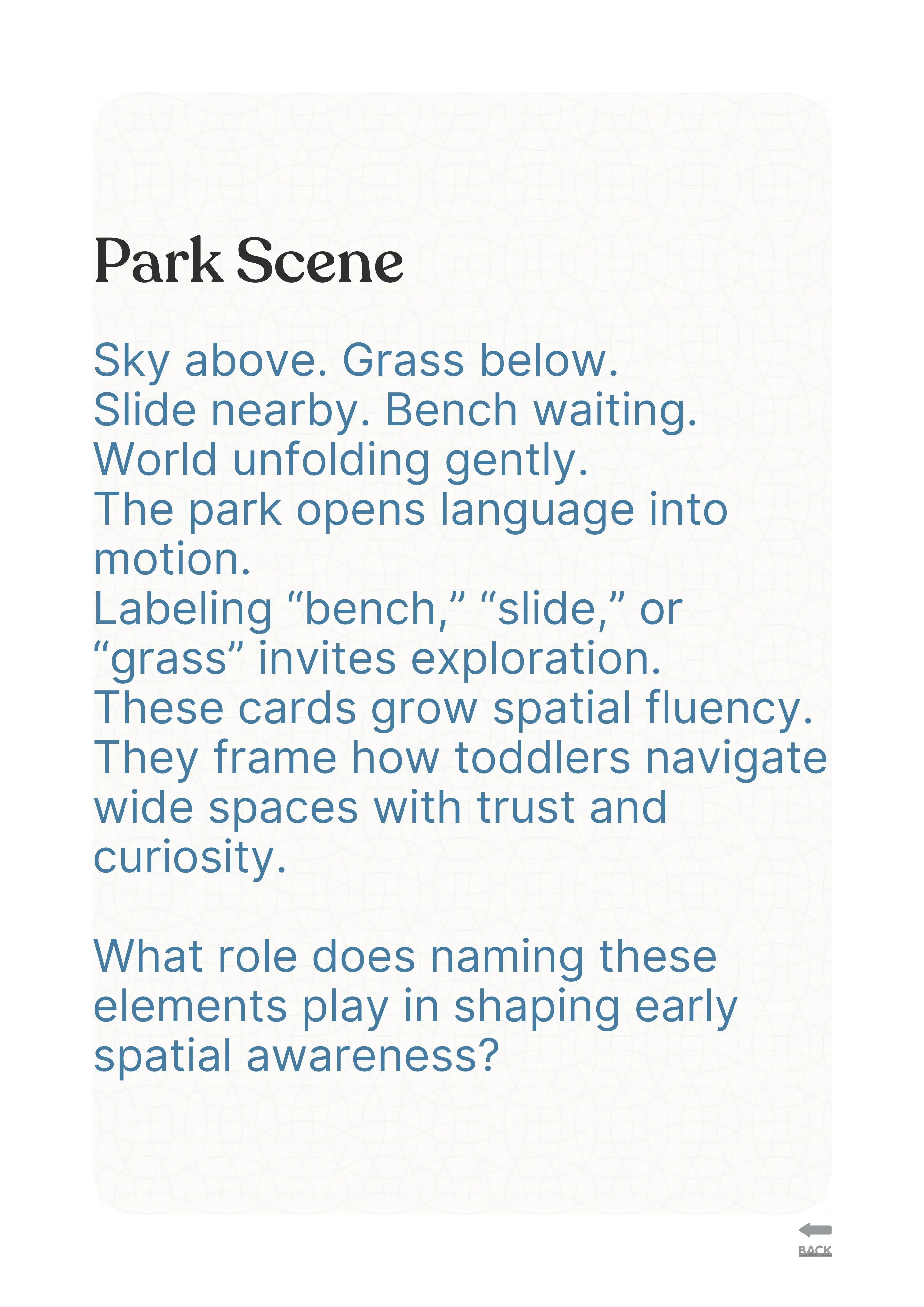
GuideCard™
Direction for deliberate practice.
The GuideCard™ provides sequenced instructions for each PrimoCard™ session within the phase. When to introduce the scene. How to establish shared attention before offering vocabulary. How to follow the child's attentional shift. When to repeat a vocabulary sequence. When the session has given what it can give and the natural close has arrived. Each GuideCard™ carries the guide through a defined session structure so that consistency is built into the practice from the beginning.
First Impressions™ Phase Set
The three instruments of Phase IV do not operate as separate resources. They function as a coordinated session architecture, designed to work together within each interaction to create the conditions under which contextual language acquisition occurs.
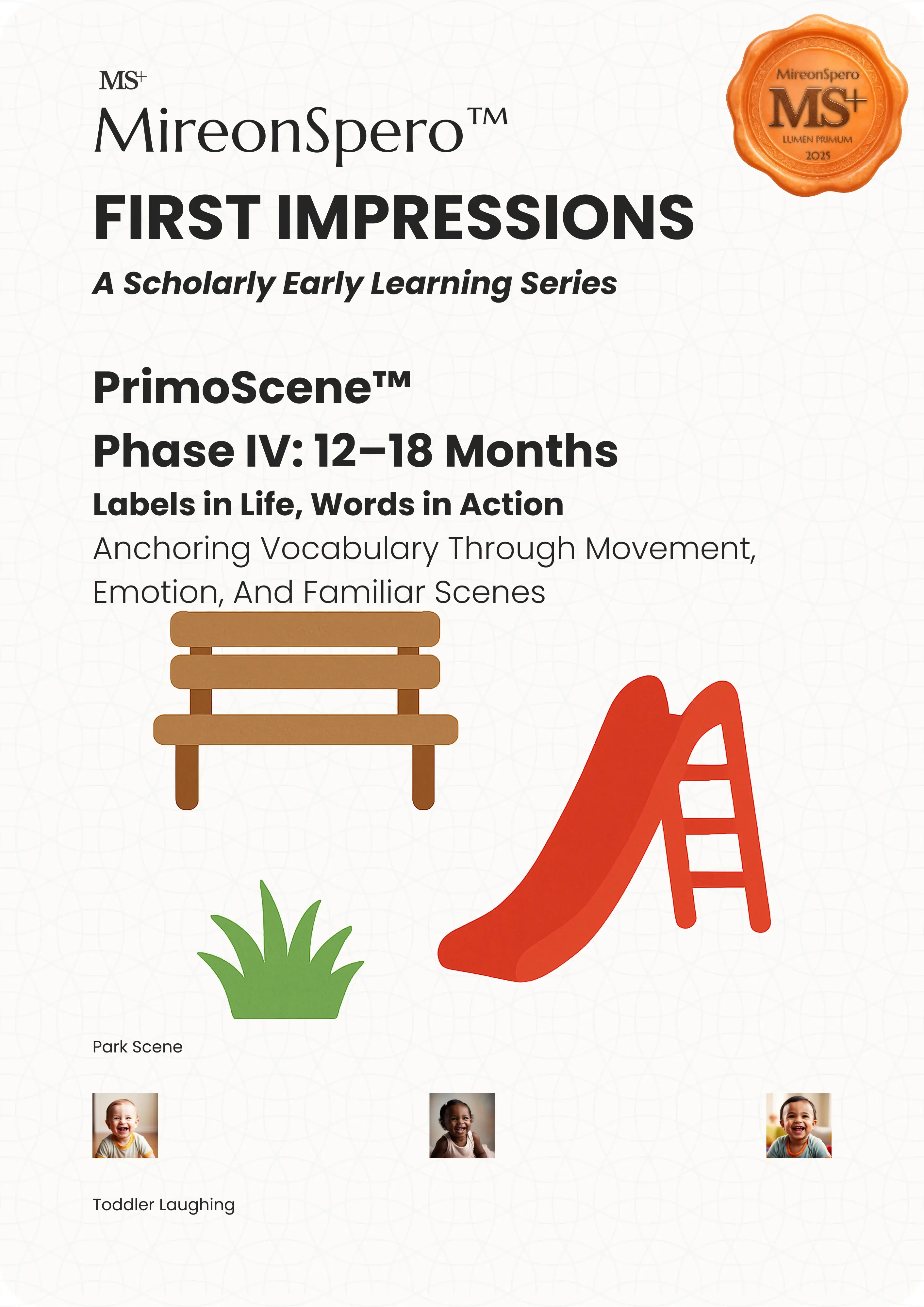
Each card in this set is organized around a distinct scene category drawn from the child's lived world. The scenes are structured attentional environments, designed to draw the child's focus toward the vocabulary-bearing elements of the scene and hold it long enough for the guide to offer the label within the shared moment.

The guide's operational framework across the phase. The Guide provides the session architecture, the vocabulary sequencing logic, and the attentional alignment principles that organize each interaction into a deliberate language-development event. Guides who work within this framework approach each session with structural clarity rather than reconstructing the day's practice from instinct.
The continuity layer of the phase experience. These materials anchor what was observed across sessions, document vocabulary emergence, and give the guide a structured record of the phase as it develops. They are the mechanism through which individual sessions accumulate into an organized account of the child's lexical development across the full phase window.
Each element has its structural role. Each role is required. The value of the suite is the integration of all three within one coherent framework of scene-grounded language engagement.
What Happens When a Scene Becomes a Word
There is a particular moment in this phase that every guide who has lived through it will recognize precisely.
You are at the kitchen table. You are holding the PrimoCard™ that shows a morning breakfast scene. The child is attending to the card with unusual stillness, the kind of stillness that signals genuine focus rather than passing curiosity. You say the word for the cup in the scene.
They look at the cup on the table beside the card.
The look is not accidental. The child has made a connection.
Their head turns deliberately. Their eyes find the cup. They look back at you. In that moment, a lexical node is forming. The word is being indexed to the object across two different contexts simultaneously, which is the mechanism through which a word moves from a sound attached to one specific instance to a concept that applies across all cups everywhere.
The biological process is called cross-situational word learning. What the guide experiences is something simpler and more complete than that.
You feel that the word has landed.
The uncertainty that accompanied the fifty previous times you said "cup" in other contexts does not fully resolve. But it loses authority. You have watched the connection form in real time, in the movement of a child's eyes from a picture to an object and back to your face. Something was built here that was not present before.
You do not require verification beyond what you have just seen.
The Shape of a Language-Rich Day
Something changes in the weeks after scene-grounded practice becomes established.
The day acquires vocabulary. Not in the sense of a lesson that occupies a defined period and then ends. In the sense that moments throughout the day become intelligible in a new way. The breakfast table is a scene now. The park has a vocabulary. The bath has one too. The walk to wherever you walk becomes an occasion for language rather than a gap between events.
You notice things that you would not have noticed before. The particular moment when the child's attention sharpens before a word attempt, the small preparatory stillness that precedes a first attempt at a difficult word. The way a word first encountered at the kitchen table reappears several days later in a completely different context, offered by the child without prompting, as evidence that the encoding held.
These observations are not performances of parental attentiveness. They are the natural consequence of a guide who now has a structured framework for reading vocabulary emergence.
Evening carries a different texture. The question is no longer whether enough language was offered. The question is more specific and more answerable: which scene did the day provide, and which vocabulary was embedded within it. The record exists. The practice continues tomorrow. The accumulation is organized.
Structure does not replace what the guide already brings. What structure provides is a container for that attentiveness. A framework within which the instinct to offer language becomes a deliberate and consistent practice with a visible developmental logic behind it.

Why This Phase Window Demands Its Own System
The Twelve-to-Eighteen-Month Window in Full
The twelve-to-eighteen-month window is not simply a phase of language growth. It is a phase of mechanism formation.
What is established in this window is not primarily a vocabulary count. What is established is the internal architecture through which the child acquires language from this point forward. The joint attention capacity that is calibrated in this window becomes the primary channel through which all future vocabulary learning flows. The contextual encoding habits that form here persist into later phases of language development.
Developmental researchers describe this window as one of the most significant in language acquisition precisely because of this architectural quality. The vocabulary that accumulates here matters. The mechanism by which it accumulates matters more.
This is why the twelve-to-eighteen-month window warrants a system rather than an aggregation of good intentions. Attentive guides already offer language throughout the day. The question this window asks is whether that language is being offered in a way that builds the mechanism as well as the vocabulary.
Scene grounding, attentional alignment, and tonal coherence are not instinctive practices. They are the specific conditions that the developmental science of this window identifies as most relevant to durable acquisition.
Two guides can occupy this same window with equal commitment to their child. Both offer words throughout the day. The one who understands the mechanism behind this window organizes those acts into a coherent practice. The practice builds the architecture. The vocabulary follows.

Phase IV Within the Full MireonSpero™ Architecture
PrimoScene™ is the fourth phase of ten. Each phase within the First Impressions™ continuum is a complete developmental unit. Phase IV is purposeful and sufficient within its own window. The guide who enrolls in Phase IV is not committing to all ten phases. They are entering the one phase that corresponds to where their child is now. What follows is governed by where the child grows.
Phase IV occupies a specific structural position within the continuum. It receives the perceptual and early language foundations established in Phases I through III and delivers to Phase V a child whose lexicon is grounded in lived context and whose joint attention capacity is calibrated for the symbolic reasoning and early numeracy that Phase V introduces. The scene-grounded vocabulary of PrimoScene™ becomes the semantic foundation upon which PrimoCognia™ builds counting, categorization, and early conceptual reasoning.
The ten-phase architecture continues beyond that into phonological awareness, cross-domain abstraction, structured academic reasoning, civic thinking, and finally the ethical reasoning and systems foresight of Phase X. The continuum was designed to accompany the full span of early cognitive development.
That span begins, for every child, in a specific sensory present. For Phase IV, it begins in a kitchen, or a park, or a room where a small person is pointing at something and turning to look at the guide who holds their language.
It begins with a scene, and a word that fits inside it.
What This Phase Is, and What It Provides
PrimoScene™ will not produce a child who speaks ahead of their developmental trajectory.
It will not guarantee vocabulary milestones, expressive language targets, or any specific measure of communicative performance. It will not remove the ordinary variability of early language development, which remains individual and uneven and shaped by factors that no enrichment framework controls.
It will give you something more useful than any of those things.
It will give you a structured understanding of how vocabulary is actually built in this window, so that the language offered throughout the day is organized by design rather than accumulated by hope. It will give you a session architecture that makes scene-grounded engagement a consistent practice rather than a best-effort approximation. It will give you the observational framework that allows a guide to recognize vocabulary emergence when it occurs, rather than waiting for the fully formed word as evidence that learning happened.
It will give you the specific confidence that comes from knowing what you are doing and why it matters at this particular stage. Not the confidence of reassurance. The confidence of understanding the mechanism you are working with, and meeting it with a structure worthy of its precision.
The twelve-to-eighteen-month window moves through at the same pace for every child and every guide.
It passes differently when you know how to build the scenes that carry the words.
For the Guide Who Has Read This Far
You did not arrive at this section by accident. You are the kind of guide who reads the reasoning before making the decision. Who wants to understand the mechanism, not just the outcome. Who feels the weight of the twelve-to-eighteen-month window as a specific developmental responsibility, not a generic phase of parenting.
The decision you are weighing has already been substantially made. The question that remains is practical: at what depth of structure do you want to meet this window.
The joint attention capacity your child demonstrates today is being calibrated by the quality and consistency of the scene-grounded interactions they encounter. This is not a countdown. It is a description of what is actively underway in the developing mind of the child you are holding responsibility for.
The window is open. The mechanism is in formation.
The Three Ways to Begin
The foundational architecture of Phase IV. Scene-grounded vocabulary frameworks, joint attention calibration references, and session documentation instruments organized for consistent daily practice. This is where deliberate, structured language engagement begins.
Deepened engagement through sequenced scene categories, tonal coherence guides, and fidelity-based progression tracking across the full phase window. Every session is structured. Every observation has a frame. Consistency is built into the practice, not dependent on the energy of the day.
The complete operational architecture of Phase IV. The full governing playbook, the multi-guide alignment tools, the extended tonal reference suite, the long-form vocabulary emergence tracking instruments, and at its center, the LexiMotion™ Integration Playbook: one hundred eighty days, structured week by week, from the first session to the last.
This edition does not do more for your child. It does more for you as the instrument through which your child's earliest language development is guided. That distinction is the entire point.
A Note on the Enrollment Model
MireonSpero™ operates under an academic enrollment structure. Phase IV is a complete developmental unit. Enrollment is a single tuition across the phase duration, not a recurring subscription, and not a product purchase in the conventional sense.
This structure reflects the institutional character of what is being entered. The guide who enrolls is not purchasing a product. They are enrolling in a structured phase of their child's developmental education, with all the commitment that enrollment implies.
Tuition is final upon enrollment. This is the standard of institutions that ask their participants to arrive with full intent rather than provisional interest. If you have read this narrative completely, you already understand the reason for that standard.
The twelve-to-eighteen-month window will complete itself. The vocabulary acquisition mechanism will continue forming, in whatever conditions the guide provides for it.
The scene-grounded interactions will accumulate, organized or otherwise, into whatever lexical architecture the child carries into the phases that follow.
The guide has one decision to make.
Whether to meet this window with the structure the mechanism deserves.
If the answer is yes, the enrollment is open.
MireonSpero™ First Impressions™ · Official Global Enrollment