

The First Word Already Inside Them
Before the word arrives, there is the reaching.
Not the physical reach, though that comes too, small hands extending toward a cup, toward a face, toward the corner of a room where a familiar sound has just ended. This reaching happens in a space the eye cannot find. It happens in the gap between what the child sees and what they have not yet learned to name.
Your child has been watching the world with increasing precision for months. Objects have become familiar. Faces have taken on meaning. The dog that crosses the room is not a passing shape. It is a presence the child has already begun to organize within themselves.
The naming has not yet arrived. The architecture for it has.
This is the window in which the word meets the world it belongs to. The neurological infrastructure of early language is not a future event. It is a present construction, building itself across every shared moment of sustained attention, every repeated encounter with a familiar object, every instance in which a voice and a thing appear in the same field of awareness at the same time.
This phase is about that convergence.
Not the dramatic arrival of speech. The quiet, structural work that makes speech possible.
The Silence That Follows the Naming
You have been naming things for weeks.
Cup. Ball. Dog. Your own name, offered to a face that has not yet returned it in kind. You say the words with care and repetition, with the particular patience of someone who understands that something is forming even when nothing visible confirms it. And then the day ends, and the word has not come back, and the silence of that unreturned naming sits with you longer than you expected.
The question is not whether you are doing enough. You are doing what every attentive caregiver does: pointing, naming, repeating, watching. The question is different, and more precise.
Is the repetition calibrated correctly? Is the pairing of object and word landing in the sequence the child's cognitive system is prepared to receive?
These are not the questions of an anxious parent.
They are the questions of a guide who is paying close attention to the right things.
The babble is present. The engagement is present. The watching is present.
The uncertainty in this window is not a sign that development is stalled. It is a sign that the developmental domain of this phase is invisible by design. The binding of word to object happens below the surface of observable behavior, in neural pathways that will only become legible when the word finally appears.
The caregiver who feels the weight of this invisible work is the caregiver who understands what is at stake in these months. That understanding is the correct foundation. The framework comes next.
What Happens When a Word and a World Meet
The Architecture of the Infant Lexical System
Between six and twelve months, the child's brain is constructing what developmental scientists call the lexical network. This is the neurological architecture through which sounds become labels and labels become retrievable knowledge. It is not built in a single moment of first speech. It is assembled through repetition, through the alignment of auditory input with visual and tactile experience, through the cumulative effect of encountering the same pairing in the same reliable context, across days and weeks.
Longitudinal inquiry into the critical period for phonetic learning established that infants in this window are in a phase of maximum sensitivity to the sound structures of language. The developing auditory cortex is not simply receiving sound. It is analyzing it, mapping phonemic patterns, and building a statistical model of the sound system the child is embedded in.
Research on joint attention provided a second foundational insight. Language acquisition in early infancy is not primarily about a child hearing words in isolation. It is about a child and a caregiver sharing focus on a common object or event, at the same moment, with the word arriving inside that shared focus.
This is the biology of first naming.
Subsequent inquiry into early word learning further clarified the mechanism. Infants track the caregiver's attentional focus and assign the word to the object the caregiver is attending to. The word does not arrive in isolation. It arrives inside a relationship of shared attention, and it is that relationship that carries the word into meaning.
The distinction between incidental naming and structured lexical engagement is where the design of this phase begins.
The Question the Naming Is Really Asking
When a caregiver holds an object in front of their child and says its name, they believe they are teaching the child a word. In the most direct sense, they are right. They are also doing something larger, which most caregivers do not have language for until they encounter the developmental research that names it.
They are constructing a shared attentional environment. They are positioning themselves as the interpreter of the world for this child. They are establishing, through repeated and structured encounters, the principle that objects have names, that names are stable, and that the caregiver is the reliable source of those names.
The role this requires of the caregiver has a precise name in the developmental literature.
It is not parent in the generic sense. It is guide. The guide in this phase is not simply speaking to the child. The guide is organizing the child's attentional environment so that language acquisition has the conditions it requires.
A guide who improvises naming, who offers words in whatever order and context the day presents, is working within the limitations of chance. A guide who operates within a structured framework knows which objects to introduce and in what sequence, how to present them within consistent shared attention, and how to document what has been observed so that the practice builds coherent momentum across the full phase window.
The question beneath a caregiver's uncertainty in this phase is not whether their child will learn to speak. It is whether they are the guide their child's developing lexical system requires. That question has an answer, and it is structural, not intuitive.
Phase III: PrimoMatch™
An Institutional Statement of Scholarly Purpose
System Identity and Phase Position
MireonSpero™ First Impressions™ is a structured global learning continuum designed to support cognitive development from early visual perception through organized abstract reasoning. The system advances through ten defined phases, each corresponding to a distinct developmental window governed by an internal sequence that reflects the progression of the human mind from sensory encounter to structured thought.
Phase III, designated PrimoMatch™, operates within the developmental window of six to twelve months. This phase addresses the period in which the infant's developing neurological architecture begins to support the binding of auditory labels to perceived objects. It is characterized by the emergence of joint attention as a cognitive capacity, the rapid growth of receptive vocabulary, and the earliest formation of the lexical network through which language becomes retrievable knowledge.
PrimoMatch™ does not seek to accelerate the natural process of language emergence. It seeks to organize the conditions within which that process unfolds, providing the guide with a structured framework for consistent, evidence-informed lexical engagement across the full span of the phase.
Scholarly Foundation
The design of PrimoMatch™ draws upon established findings in early language development, joint attention research, and the neuroscience of lexical acquisition.
Research into the critical period for phonetic learning identifies the six-to-twelve-month window as a period of heightened sensitivity to the phonological structures of language, during which the infant's auditory cortex is actively constructing the sound map that will underpin all subsequent word learning. Research on joint attention establishes that language acquisition depends not on hearing words in isolation but on encountering words within shared attentional focus between caregiver and child. Studies in referential word learning clarify that infants in this window track caregiver attention when mapping new words to objects, making the caregiver's attentional direction a primary variable in lexical encoding. Research on early vocabulary development documents the normative range of receptive and expressive vocabulary growth across this window, providing the developmental benchmarks that inform the phase's progression structure.
Three Governing Principles
The naming encounter is structured so that the word arrives within shared attention on the object it names. The guide's gaze and the child's gaze meet at the same object before the word is spoken. This alignment is the condition under which lexical encoding is most available to the developing mind.
The same pairings are encountered across multiple sessions, in consistent contexts, over the course of the phase. Repetition is not redundancy. It is the mechanism through which a provisional pairing becomes a stable encoding. The phase's progression structure is designed to deliver repetition in a sequence that reflects the documented patterns of early word learning.
The phase advances incrementally from high-frequency, familiar objects toward a broader set of named referents. Expansion is calibrated to the child's demonstrable receptive knowledge. New words are introduced as prior pairings have stabilized, maintaining the developmental logic of the phase rather than accumulating vocabulary in advance of encoding capacity.
The Caregiver as System Operator
PrimoMatch™ is designed for the guide, not for the child in isolation. The materials organize the lexical content of the phase and calibrate its presentation. The guide provides the attentional relationship within which that content becomes developmentally meaningful. The quality of joint attention the guide establishes, the consistency of naming practice across sessions, and the discipline of working within the phase's structured progression determine the character of the lexical engagement the child receives.
Guides are supported to observe the child's responses within a structured framework of reference points. Shifts in gaze behavior when a familiar name is spoken, orientation toward a named object before it is pointed to, and the first instances of sound production in the presence of a named referent are all documented as evidence of engagement within a developing lexical system. These observations are not performance measures. They are the visible surface of a process that builds below the threshold of easy perception.
PrimoMatch™ is an enrichment framework. It is designed to complement attentive caregiving and may be used alongside established pediatric guidance. It is not a speech therapy intervention. It does not replace professional evaluation of language development. It does not function as a diagnostic instrument.
No assurance is made regarding the timing of first words, the rate of vocabulary growth, or the pace of expressive language development. Language development remains variable, shaped by the individual neurological profile of the child, the range of caregiving relationships in which the child is embedded, and the broader environment of the child's daily life.
The system offers a designed framework. The child brings their own readiness to that framework. These are distinct contributions. MireonSpero™ does not conflate them.
Three Editions. One Governing Structure.
Each occupies the same phase window. Each addresses the same developmental period. The distinction between them is one of scope, depth, and operational completeness.
Origin Edition
The foundational architecture of Phase III. Object-naming frameworks give the guide a reference system for daily practice. Evidence-grounded cue sequences provide language for what is being observed and why it is relevant to the phase's developmental logic. Documentation instruments create a structured record of the phase as it unfolds.
This is where principled naming practice begins. Organized, consistent, observed.
Prestige Edition
The Prestige Edition deepens practice through calibrated repetition and fidelity-based progression. Each session operates within a defined naming sequence designed to support the alignment principle across the full span of the phase window. The guide is supported not only in what to present, but in how to establish the joint attentional frame, how to pace repetition across sessions, and how to read the child's lexical response within an organized system of developmental reference points.
This is engagement designed for the guide who understands that the architecture of the practice determines the quality of the encoding.
Legacy Edition
The most complete expression of Phase III. The Legacy Edition integrates the full governing playbook with a coordinated set of instructional supports: multi-caregiver synchronization tools, extended audio guidance for caregiver voice modulation, environmental naming references, and long-form tracking instruments. Every element operates within one coherent, sustained framework.
The Primosyn™ Intelligence Playbook
A one-hundred-eighty-day sequenced guide to daily lexical engagement, organized from the earliest weeks of the phase through its close. Each week is organized within a progressive framework that advances the naming practice in alignment with the documented trajectory of early word learning. Joint attention anchors appear at defined session intervals. Caregiver cue sequences are embedded throughout.
The guide who enters Phase III with the Playbook does not face the week uncertain about which objects to name, in what context, with what pacing, or in what sequence. The week has already been designed. Improvisation is replaced by structured intent.
Language in Service of Learning
PrimoMatch™ is delivered through three primary instruments, each designed to serve a distinct function within the phase.

PrimoCard™
The primary lexical stimulus of Phase III.
Each PrimoCard™ presents a single, familiar object with visual clarity. The image is rendered with sufficient detail for recognition and sufficient simplicity for attentional focus. Objects are selected from the domains of the child's daily environment, the categories of experience the child already encounters, and the vocabulary most likely to form the earliest layer of stable lexical knowledge. Color is fully present at this phase, consistent with the visual development that Phase II supported.
The referent to which the word is attached. Its design is calibrated to the function it performs.
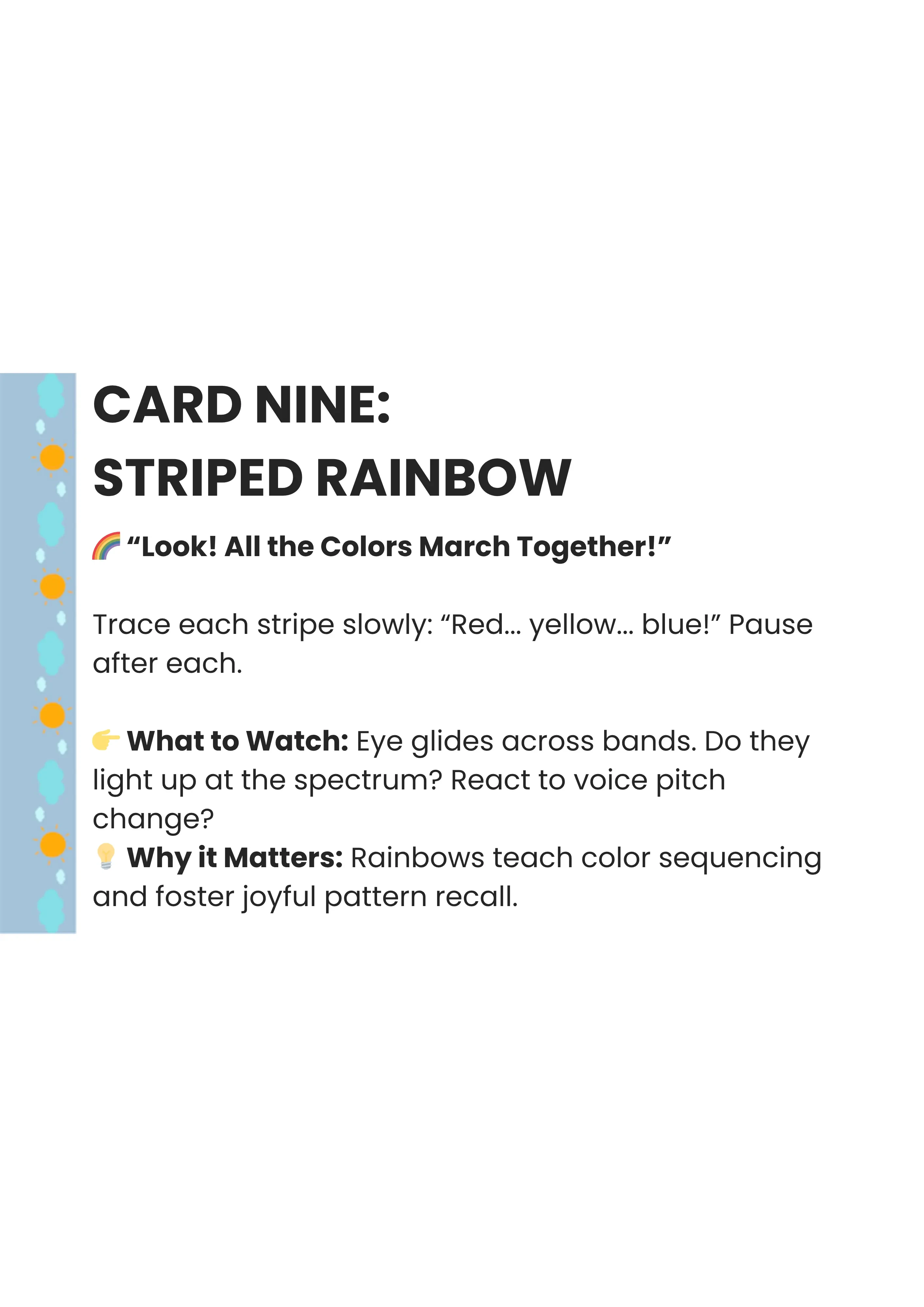
Bright Recall Card™
Structured memory support for the guide.
The Bright Recall Card™ provides session-level observation references, naming cue frameworks, and attentional anchoring prompts that allow the guide to enter each session with clarity and retain what was observed across sessions. It functions as the guide's perceptual instrument within each naming encounter. It supports the consistency of practice even when the guide's attention is divided, as it will be across the long months of this developmental window.
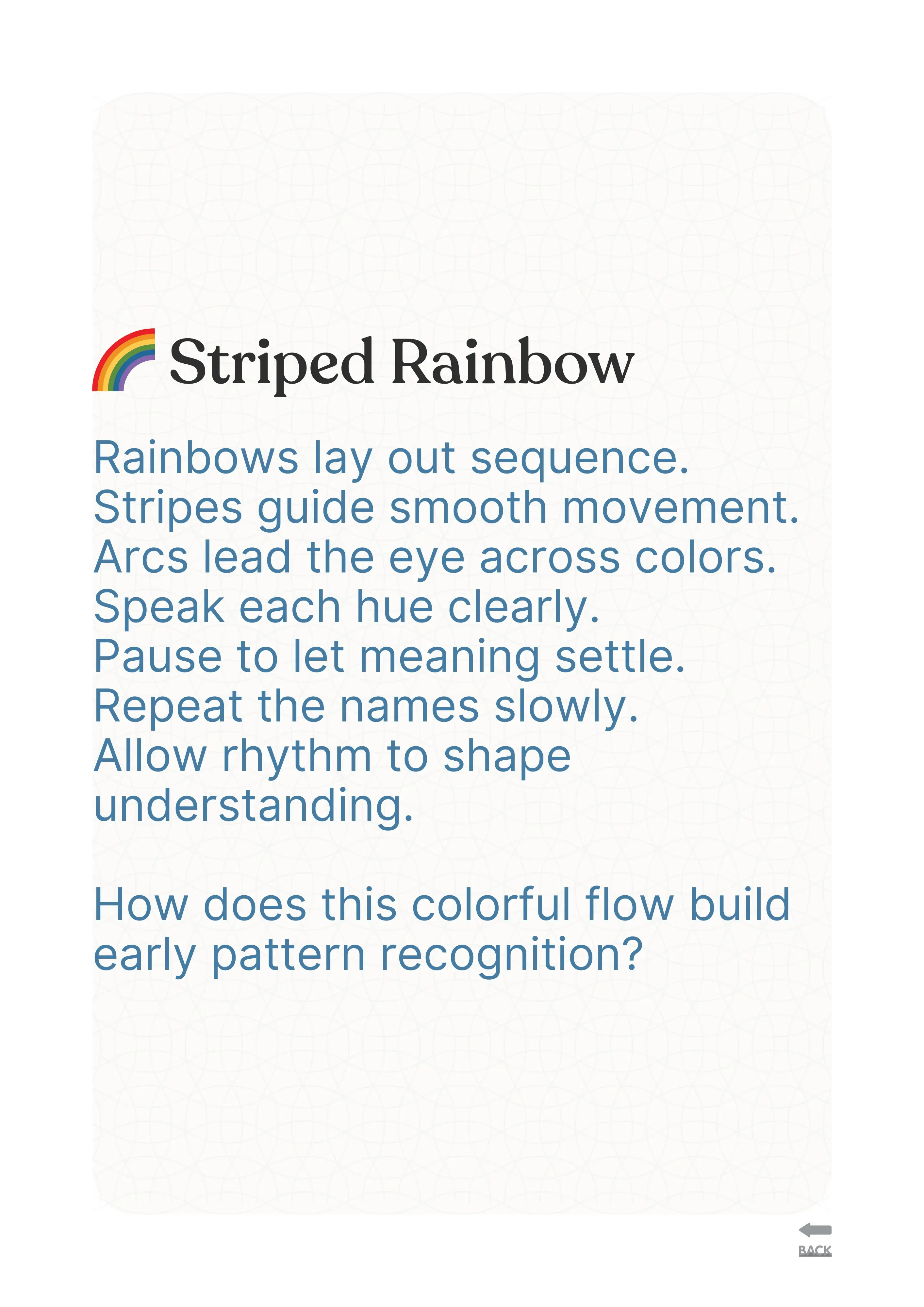
GuideCard™
Direction for deliberate lexical practice.
The GuideCard™ provides sequenced instructions for each session within the phase. Which objects to present. How to establish the joint attentional frame. How to pace the naming. What to observe. When to introduce a new pairing and when to repeat a prior one. Each GuideCard™ carries the guide through a defined session structure so that the practice accumulates coherent developmental momentum rather than recurring as an isolated, unconnected series of naming events.
First Impressions™ Phase Set
The three instruments of Phase III do not function as standalone materials. They are designed to operate together within each session, and their integration is the condition under which the session becomes a complete lexical encounter.
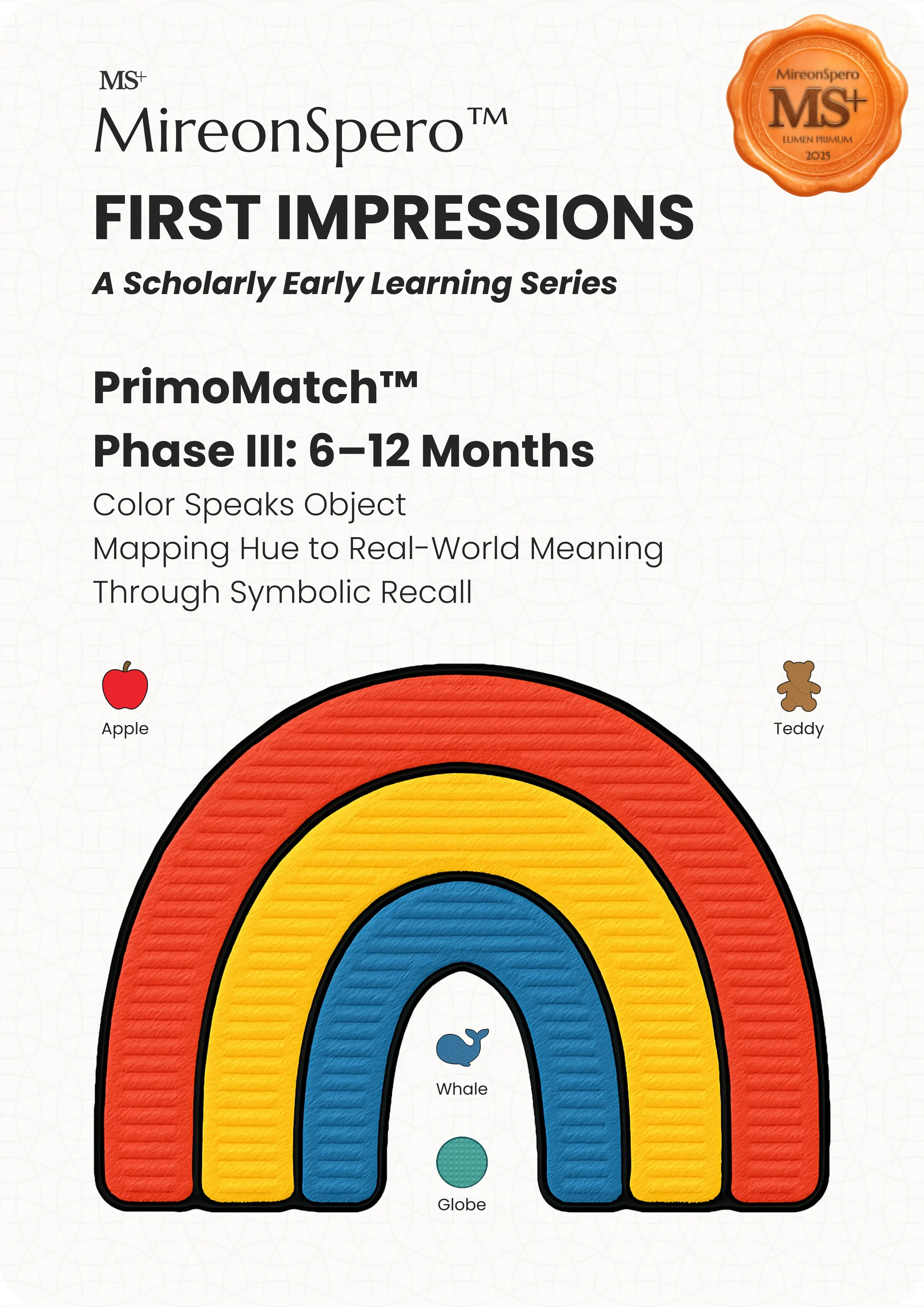
Each card in this set is selected and designed to present a single named referent within a visual field organized for attentional clarity. The cards deliver the lexical content of the phase: the objects, the categories, the familiar referents to which early words attach.

The guide's operational reference across the phase. The Guide organizes each session within a coherent naming practice, providing the sequencing, the attentional cues, and the observational language that turn a moment of shared focus into a deliberate act of lexical engagement.
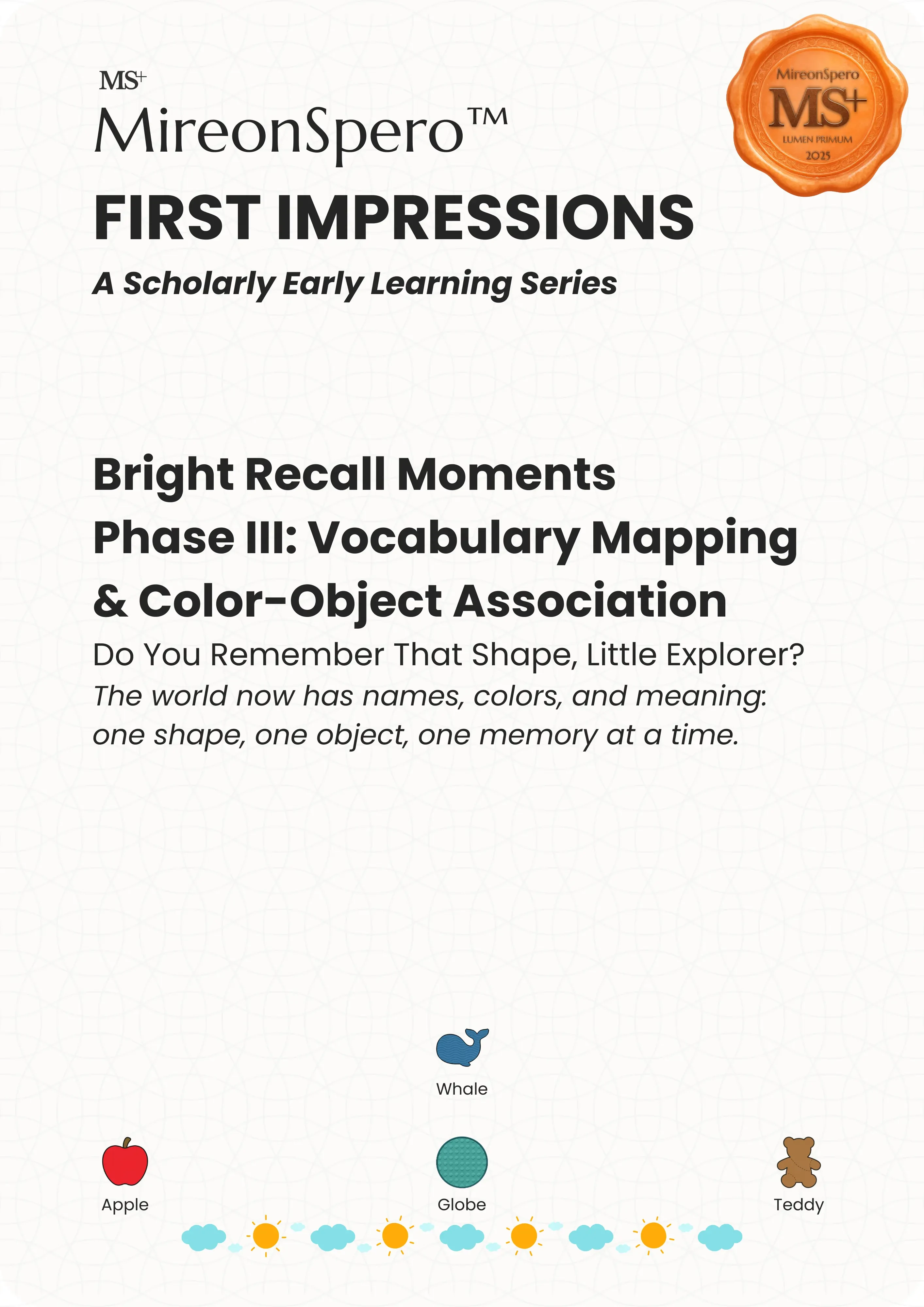
The reflective layer of the phase experience. These materials anchor what was observed across sessions, support continuity in the guide's practice, and build a structured record of the phase as the child's lexical development progresses.
Each element has its defined role. The value of the suite is in the integration of all three within one coherent structure of shared attentional engagement.
What Changes When the Word Arrives
There is a particular moment, and caregivers who have been practicing this phase carefully will recognize it before it is described, when the direction of the exchange reverses.
You hold the card. You have held it before, many times, in many sessions. You say the name as you have learned to say it, with your gaze on the object, your attention directed where the child's attention is being invited. And this time, before you finish the word, the child's eyes move.
Not toward you. Toward the card.
The gaze arrives at the referent before the word has fully resolved in the air.
Something in the child's developing lexical system has connected the sound to the object with enough stability to anticipate the referent from the word's first syllable. The association that has been forming across weeks of repeated, structured naming encounters has reached a threshold of retrieval.
What is visible in this moment is the surface of a process that the developmental neuroscience of Phase III describes precisely. A stable pairing has formed in the lexical network. The phonological form of the word has achieved sufficient encoding to activate the stored representation of the object before the object is re-presented.
Weeks of structured naming practice have been building toward exactly this form of response. The practice was correctly structured. The alignment was present. The repetition was sustained.
The child's developing lexical system has done what it was prepared to do. The uncertainty loses its authority. The guide has witnessed the invisible becoming visible.
The Shape of the Days After
Something changes in the weeks after a consistent naming practice has been established.
The day carries a different kind of attention. The guide brings a specific perceptual awareness to ordinary moments: the way the child's gaze lingers on a named object after the session has ended, the sound that emerges at a familiar referent encountered outside the structured session, the quiet evidence of a pairing that has taken hold in the child's daily experience.
The sessions themselves change in character. What began as a discipline of consistent repetition becomes something more fluent. The guide knows the sequence. The child anticipates certain pairings. Shared attentional focus arrives more readily. The joint attentional frame, which required deliberate construction in the early sessions, becomes a habitual quality of the interaction.
These are not the observations of a parent scanning for milestones. They are the observations of a guide who has learned to read a developing lexical system.
The evenings carry a different weight as well. The documentation of the session has its own rhythm. The Bright Recall Moments are a record of the phase in progress: which pairings have stabilized, which are still forming, what the child's attentional behavior is suggesting about the readiness of the lexical system for new introductions.
This is what structure gives to a guide who was already paying the right kind of attention. The attention was already present.
The framework gives the attention a precision it could not have generated on its own.

Why This Six-Month Arc Is What It Is
The Science of the Developmental Window
The six-to-twelve-month window is not simply the period before a child begins to speak.
Developmental science describes this period as the phase of maximum phonological sensitivity, the months in which the infant's auditory cortex is most actively building the statistical model of the sound system it is embedded in. The window is also the phase in which joint attention emerges as a cognitive capacity, making the triadic structure of caregiver, child, and named object available for the first time as a vehicle for word learning.
These two developments, phonological sensitivity and joint attention, are the biological preconditions for lexical acquisition. They do not persist at the same level of availability indefinitely. The phonological sensitivity of this window reflects a specific period of cortical plasticity.
The word foundational, as developmental scientists use it in reference to this phase, carries a precise technical meaning. The lexical network built in this window does not determine the full scope of the child's later language. It establishes the structural foundation upon which subsequent vocabulary, grammar, and expressive language development build.
Two guides stand in the same room with the same child during the same developmental window. Both are attentive. Both care for the child with the full force of that care. One operates within a structured framework that organizes the naming practice in alignment with how the developing lexical system builds its architecture. The other brings the same love and the same attention, and names things as the day allows.
Both are present. Only one has the full design of what this window requires working in their favor.

Phase III Within the Full MireonSpero™ Architecture
PrimoMatch™ is the third phase of ten. The system does not ask the guide to commit to all ten phases at the outset. Each phase is a complete, self-contained unit within its developmental window. Phase III is sufficient and purposeful on its own. The guide enters here because this is the window in which the child is. What comes after is governed by where the child's development leads.
The ten-phase architecture exists because the formation of a capable mind does not conclude at twelve months. PrimoMatch™ builds the lexical foundation. Phase IV enters the child's developing language system into the world of context: words in motion, objects encountered within daily scenes and emotional situations. Phase V introduces the earliest architecture of symbolic reasoning, numbers and categories and the logic of simple relationships.
MireonSpero™ was designed to accompany that full span. It does not define its shape or guarantee its character. It provides a structured, evidence-informed framework for the guide at each stage of the journey.
That journey, for this phase, begins at a moment that is already underway. A child in the sixth month of their life is in the earliest weeks of the window in which the world begins to have names. The guide who brings structure to this moment is not interrupting a natural process. They are entering it with design.
It begins with naming.
What This Is, and What It Is Not
PrimoMatch™ will not produce a child who speaks early.
It will not compress the developmental timeline of expressive language or guarantee that first words appear within a particular window. It will not accelerate the child beyond the parameters of their individual neurological readiness. It will not resolve the uncertainty that lives at the heart of a developmental process that is largely invisible until it surfaces in observable behavior.
It offers something more reliable than any of those things.
It provides a structured framework for the practice of joint attentional naming, organized in alignment with the documented science of how lexical encoding builds in the six-to-twelve-month window. It provides the observational language that allows the guide to watch the development of early language with precision rather than anxiety. It provides the continuity of documented practice across a phase that requires sustained engagement, not episodic attention.
The guide who enters Phase III with this framework does not know when the first clear word will arrive. No framework can produce that knowledge. What the guide does know is that the conditions for lexical encoding are being created with care, structured by evidence, and sustained across the developmental window with the consistency that the child's building lexical network requires.
The six to twelve months pass the same way whether or not a guide brings structure to them.
They pass differently when the naming inside them is organized into the architecture the developing mind was prepared to receive.
For the Guide Who Has Read This Far
You did not arrive here through a general curiosity about early learning products. You arrived here because you are the kind of guide who takes the invisible seriously. The developmental work of the six-to-twelve-month window does not announce itself in real time. There is the child's attention. There is the naming practice you bring to it. There is the space between those two things, where the lexical network is building itself from the material you provide.
You already know what you are going to decide.
Not because a deadline is approaching. Because the window is currently open. The child in your care is in the developmental phase in which joint attention and phonological sensitivity are simultaneously available. The lexical network is being built from the naming it receives. Structured engagement creates a different architecture than incidental exposure. The difference is being made in the present, in each session, in the accumulated weight of consistent aligned naming practice across the full phase.
Both paths are present in every developmental window. Only one carries a designed framework.
The Three Ways to Begin
The foundational architecture of Phase III. Structured naming frameworks, observational documentation, and evidence-grounded cue references for consistent daily joint attentional engagement. This is where principled naming practice begins.
Sequenced lexical engagement protocols, fidelity-based progression across the phase, and a systematic framework for building from first pairings through stabilized receptive vocabulary. Every session is guided. Every observation has a frame.
The most complete expression of Phase III. The full governing playbook. Multi-caregiver synchronization tools. Extended audio guidance. Environmental naming references. Long-form tracking instruments. And at its center, the Primosyn™ Intelligence Playbook: one hundred eighty days, structured week by week, from the first session through the close of the phase window.
This edition does not do more for the child in isolation. It provides the guide with the most complete operational instrument available for organizing, observing, and sustaining the practice of structured lexical engagement across the full Phase III window.
A Note on the Enrollment Model
MireonSpero™ operates under an academic enrollment structure. Phase III is a complete developmental unit. Enrollment is a single tuition across the phase duration, not a recurring subscription, and not a product purchase in the conventional sense.
This structure reflects the nature of what you are entering. You are not buying materials. You are enrolling in a phase of your child's structured developmental education, with all the seriousness and all the commitment that the word enrollment implies.
Tuition is final upon enrollment. No returns. This is the standard of every serious institution that asks its participants to arrive with full commitment rather than provisional interest. If you have read this narrative completely, you already understand why.
The six-to-twelve-month window will not return. Not in a threatening way. Simply in the ordinary, irreversible way of all developmental periods. The phonological sensitivity of this window, the peak availability of joint attention as a vehicle for lexical encoding, the period in which the naming that happens will form the first layer of the lexical network, all of it proceeds whether or not a structured framework is present.
The guide has one decision to make.
Not whether to love this child. That was decided before this page existed.
Whether to meet this window with the structure that the science of early lexical development shows it deserves.
If the answer is yes, the enrollment is open.
MireonSpero™ First Impressions™ · Official Global Enrollment