

The First Color
Before a child learns the name of a color, they feel its pull.
Color does not arrive all at once. It comes the way a season does, gradually and without announcement, until one ordinary morning the world looks different from how it looked before. The infant who spent their earliest weeks finding edges in the dark and the light now begins to find something else. Not shape alone. Not contrast in its simplest form. The first glimmer of a world that holds distinct hues, beginning with one.
Red arrives before any other.
This is not poetic convention. It is the documented sequence of chromatic development in the human visual system. The red-sensitive cones in the developing retina mature ahead of the others. Before blue resolves cleanly, before green separates from its neighbors in the visual field, red presents itself with unusual clarity to the three-month-old mind.
What the child sees, before they can form a word for any of it, is a world where one color arrives first and announces itself.
You may have already felt the shift before you understood it. Something changed in how they looked at a particular object. The attention held longer than it used to. The eyes returned to the same place twice.
That returning gaze is the beginning of chromatic life.
What No One Tells You About the Month Before Color
The milestone charts mention color vision. They note it somewhere in the third month, framed as something that develops. What they rarely describe is what the weeks leading into it actually feel like for a caregiver who is paying close attention.
You are watching a child whose visual engagement feels, at times, inconsistent. Some moments the gaze settles. Other moments it drifts. You hold objects at careful distances, you adjust the light, you introduce new forms, and the response you are waiting for arrives only sometimes.
The uncertainty is not dramatic. It is quiet. It sits in the gap between what you observe and what you were told to expect.
There is a particular kind of self-questioning that belongs to this developmental window.
You find yourself wondering whether you are providing the right visual environment. Whether the materials around your child are calibrated to where their perception actually is, rather than where the general descriptions of infant development suggest it should be.
Am I providing the right visual environment?
Are these materials calibrated to where they actually are?
Is this quiet, uncertain time doing something?
This question is not anxiety without basis. It is the signal of a caregiver who understands, at some level, that the transition from high-contrast form recognition to chromatic differentiation is not incidental. Color is not decoration added to a world that was already complete in black and white. It is a new layer of perceptual information. The uncertainty you carry in these weeks is not a sign of inadequacy. It is the marker of a guide who has recognized that this window deserves more than instinct alone.
What the Developing Visual System Is Building
The Architecture of Chromatic Organization
Between three and six months of age, the human visual system undergoes a period of chromatic organization that has no equivalent at any other stage of early development.
In the earliest weeks of life, the infant retina operates with limited cone sensitivity. The photoreceptor cells responsible for color vision are present but structurally immature. The visual cortex processes luminance, contrast, and spatial frequency with increasing precision. Chromatic differentiation remains constrained. The world as the newborn experiences it is organized primarily around the edges between light and dark.
By three months, the cone cells begin a period of maturation that is both rapid and sequenced. The long-wavelength cones, those responsible for red sensitivity, lead this development. They reach sufficient functional density before the medium and short-wavelength cones that process green and blue reach comparable development.
Peer-reviewed inquiry into early chromatic sensitivity documents how infant color discrimination moves through a defined developmental progression during this window. The ability to distinguish chromatic differences from achromatic variations of equivalent luminance emerges gradually, with red-green discrimination stabilizing earlier than blue-yellow discrimination.
This is the biology of first color.
Simultaneous with chromatic development, smooth pursuit matures. The saccadic eye movements characteristic of the newborn period give way to the early forms of tracking that allow the eye to follow a slowly moving target with increasing fidelity. The interplay between chromatic contrast and motion tracking during this window is not coincidental. The visual system is calibrating two capacities in parallel, and the conditions that support one tend to support the other.
The caregiver who introduces color with awareness of this sequence is working with the biological logic of the developing retina. That alignment between environmental design and neural readiness is the distinction this phase is built upon.
What the Guide Is Actually Doing
When a parent holds a red card at the appropriate distance and watches their child's gaze respond, there is a moment before understanding when they simply feel that something has happened.
What they felt is accurate.
They were not providing entertainment. They were not following a parenting trend or filling a developmental checklist. They were participating, with intention and structure, in the calibration of a visual system that is organizing the chromatic layer of perception for the first time.
That is the correct description of what happens in a structured Phase II session. The guide is not providing stimulation in the general sense. They are offering the right input, to the right system, at the right level of developmental readiness. The specificity matters.
A caregiver who understands that red presents before blue, that saturated color against a neutral background drives fixation more reliably than a complex chromatic field, and that this window is brief and does not return, operates differently from a caregiver who simply surrounds their child with colorful objects and waits for development to proceed.
The distinction is not about love. Love was never the variable. The distinction is about design.
The question beneath the uncertainty described in the preceding section is not whether the caregiver cares enough. It is whether the caregiver has a system worthy of what this window requires. That question deserves a precise answer. This phase is the answer.
Phase II: PrimoHue™
An Institutional Statement of Scholarly Purpose
System Identity and Phase Position
MireonSpero™ First Impressions™ is a structured global learning continuum designed to guide cognitive development from early visual perception through organized abstract reasoning. The system advances through ten defined phases, each corresponding to a distinct developmental window and governed by an internal sequence that reflects the progression of the human mind from sensory encounter to structured thought.
Phase II, designated PrimoHue™, represents the chromatic layer of this continuum. It operates within the developmental window of three to six months, a period characterized by the rapid maturation of cone cell density in the developing fovea, the emergence of chromatic discrimination as distinct from luminance contrast, and the progression of smooth pursuit from its earliest functional expression toward increasing fidelity of tracking.
This phase does not seek to accelerate the natural process of color perception development. It seeks to organize the conditions within which that process unfolds, providing the caregiver with a structured framework for consistent, evidence-informed chromatic engagement across the full span of the phase.
Scholarly Foundation
The design of PrimoHue™ draws upon established findings in infant visual science, chromatic development research, and pediatric observational methodology.
Research in infant chromatic development documents the sequential emergence of color discrimination in the three-to-six-month window, establishing the developmental priority of red-green discrimination and the specific role of chromatic contrast against achromatic fields in driving sustained fixation. Studies in infant psychophysics establish the psychometric framework for understanding visual preference in early infancy, providing the methodological grounding for the observational protocols embedded in this phase. Foundational research on contrast sensitivity and visual cortical organization informs the progression logic of chromatic introduction across the phase window. Studies on early gaze direction and attentional orientation provide the framework for understanding how chromatic targets interact with the infant's emerging capacity for directed visual attention.
Three Governing Principles
Chromatic introduction follows the documented order of cone maturation. Red precedes blue. Blue precedes the fuller resolution of the chromatic field. The caregiver's engagement with color reflects this sequence rather than the preferences of design or the availability of materials. Sequence is the first discipline of this phase.
Chromatic stimulation is presented against neutral fields at luminance levels appropriate to the developing retina. The visual environment is calibrated to the infant's actual perceptual capacity at each stage of the phase, not to a generalized notion of what infants find appealing. Calibration is the standard against which every session within the phase is measured.
Each week builds directly upon the chromatic foundation established in the prior week. The caregiver's observational record carries knowledge forward. The phase is experienced as a developing arc of chromatic engagement. Continuity is what transforms individual sessions into a coherent developmental progression.
The Caregiver as System Operator
PrimoHue™ is designed for the caregiver as the instrument of chromatic engagement. The materials provide the visual content. The caregiver provides the structured context within which that content becomes developmentally relevant. Presence, pacing, and attentiveness to the child's responsive state determine the quality of each session.
Caregivers are guided to observe the child's chromatic responses within a structured framework of reference points. Fixation duration on saturated targets, tracking behavior across slow chromatic movement, and differential responsiveness to the chromatic progression from red through blue and green are recorded within a system that creates a continuous observational record of the phase. This observational practice builds two things simultaneously. It creates a documented history of the child's chromatic development across the three-to-six-month window. It also trains the caregiver to perceive the specific signals of chromatic responsiveness with precision, developing an awareness that sharpens their engagement across every subsequent phase of the system.
PrimoHue™ is an enrichment framework. It is designed to complement attentive caregiving and may be used alongside established pediatric guidance. It is a structured approach to organizing chromatic engagement during a defined developmental window. It does not function as a therapeutic intervention. It does not replace professional developmental evaluation. It does not serve as a diagnostic instrument.
No assurance is made regarding the pace of chromatic discrimination development, the emergence of specific visual milestones, or the relationship between engagement with this phase and any subsequent visual or cognitive outcome. Development remains variable, shaped by the individual profile of the child and the full complexity of the environment in which the child is held.
The system offers organized conditions. The child brings their own readiness to those conditions. These are not the same thing, and this institution does not conflate them.
Three Editions. One Governing Structure.
Each occupies the same phase window. Each addresses the same developmental period. The distinction between them is one of scope, depth, and operational completeness.
Origin Edition
The foundational architecture of Phase II. Calibrated observational reference tools aligned with the earliest documented stages of chromatic sensitivity provide the caregiver with a science-grounded language for what they are seeing and why it is relevant. Session anchors and chromatic introduction sequences organize daily engagement within a consistent framework. Documentation instruments create a structured record of the phase as it progresses.
This is where principled chromatic practice begins. Practice that is regular, structured, and grounded in the developmental sequence of the three-to-six-month window.
Prestige Edition
Deepened engagement through sequenced chromatic progression protocols and fidelity-based practice. The Prestige Edition introduces dynamic contrast modules that advance in calibrated stages across the phase window. Guided observation companions provide the caregiver with structured reference points for reading the child's chromatic responses with increasing precision.
Tracking fidelity instruments allow the caregiver to monitor the progression of smooth pursuit development alongside chromatic differentiation. Every session operates within a defined progression framework, organized to support consistency from the opening weeks of Phase II through its close.
Legacy Edition
The most complete expression of Phase II. The Legacy Edition integrates the full governing playbook with a coordinated suite of structured supports: environmental chromatic audit tools for organizing the visual surround according to the developmental needs of each week, multi-caregiver coordination instruments for maintaining consistency across all adults engaged in the child's care, extended auditory companion sequences, and long-form observational tracking instruments.
The Contrast Calibration Playbook™
A ninety-day sequenced guide to chromatic engagement, structured from the opening week of Phase II through its close. Each week is organized within a progressive framework that advances in chromatic complexity as the infant's perceptual system matures: from the first introduction of saturated red against neutral fields, through the sequential entry of blue and green, through the full chromatic calibration that characterizes the close of the three-to-six-month window.
The caregiver who enters Phase II with the Playbook does not face the week without a framework. The week has been designed. The chromatic sequence has been determined. The particular uncertainty of a caregiver navigating chromatic development without a structured guide is replaced by something more useful: purposeful sequence, calibrated presence, and the clarity of knowing.
Form in Service of Chromatic Function
PrimoHue™ is delivered through three primary instruments, each designed to serve a distinct function within the phase's developmental architecture.

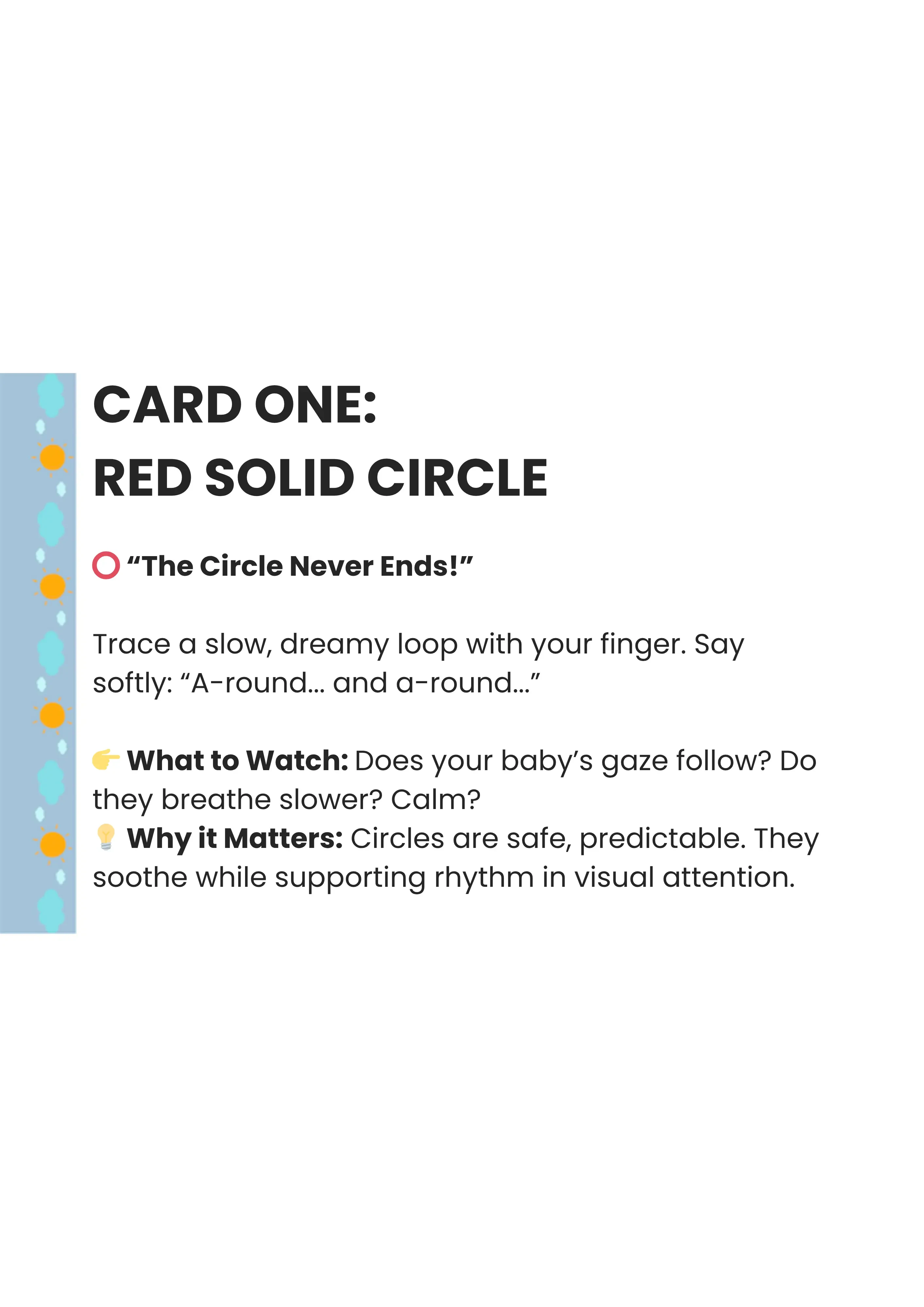
PrimoCard™
The primary chromatic stimulus of Phase II.
Each card within the Phase II set is designed against the documented parameters of developing cone sensitivity during the three-to-six-month window. Saturated hues are presented against neutral fields at the chromatic contrast levels most associated with sustained fixation in the developing visual system. The progression across the card set reflects the cone maturation sequence: red-range targets are introduced first, followed by blue-range targets, followed by the broader chromatic field as the phase advances.
A calibrated instrument for chromatic development, not a decorative object.
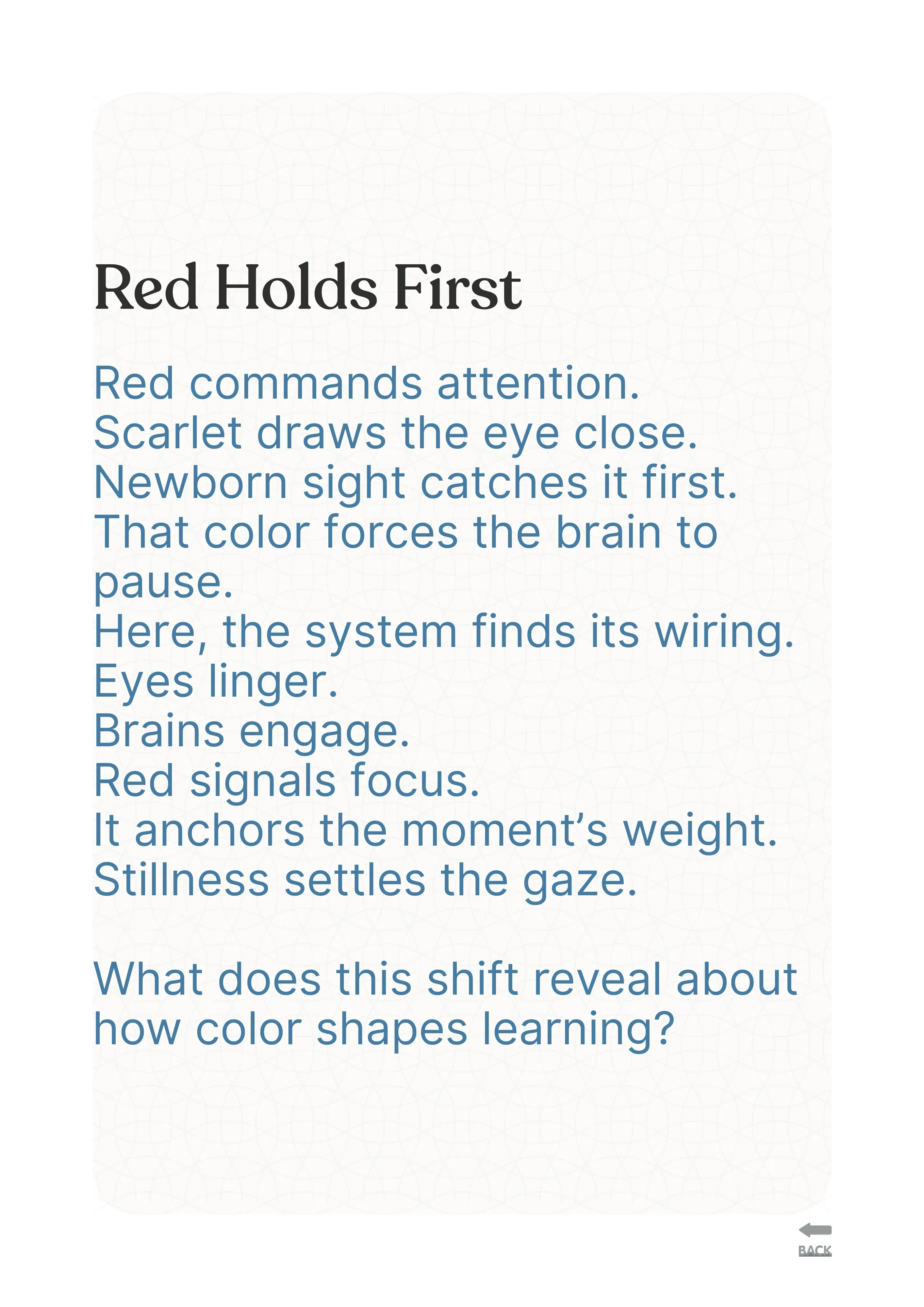
Bright Recall Card™
Structured observational support for the caregiver.
The Bright Recall Card™ provides session reference points, perceptual observation prompts, and chromatic cue frameworks that allow the caregiver to engage each session with intention and carry forward what was observed. The card gives the caregiver a reference language for tracking fixation responses, pursuit behavior, and differential reactivity to the chromatic progression across the phase.
Built so observational consistency is maintained even when the session is brief.
GuideCard™
Direction for structured chromatic practice.
The GuideCard™ provides sequenced instructions for each session within the phase: how to present the chromatic target, how to pace the exposure, what responsive signals to observe, when to advance in the sequence, and when to hold steady. Each GuideCard™ carries the caregiver through a defined session structure so that the practice remains calibrated rather than improvised. Consistency in Phase II is not incidental to chromatic development. It is one of the conditions on which the developmental architecture of the phase is built.
First Impressions™ Phase Set
The three instruments do not operate in isolation. They function as a coordinated suite, designed to work together across the span of the phase window.
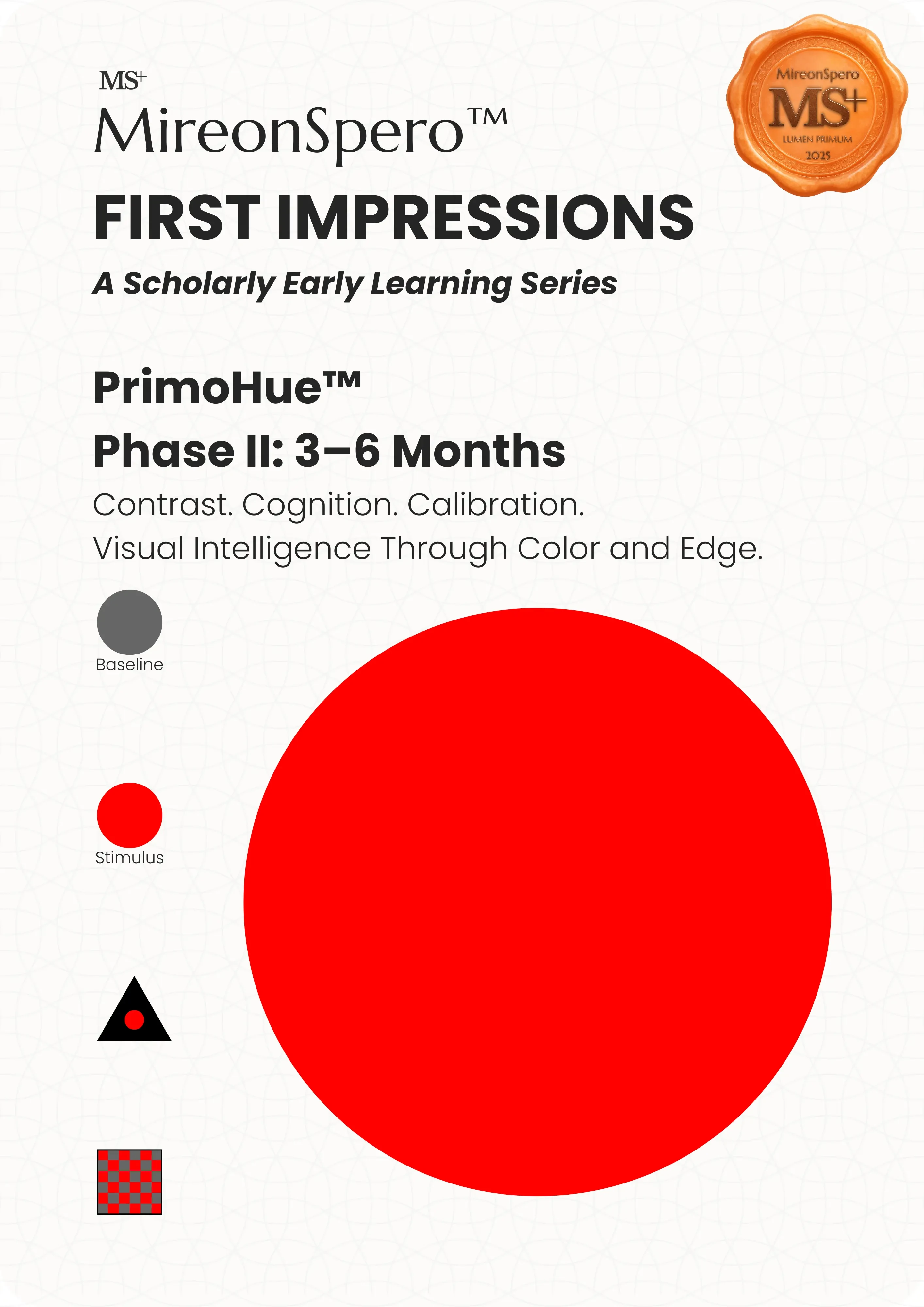
Each card calibrated to the documented parameters of cone sensitivity in the three-to-six-month window. Saturated hue against neutral field. The chromatic sequence the developing retina is organized to receive, delivered in the correct order.
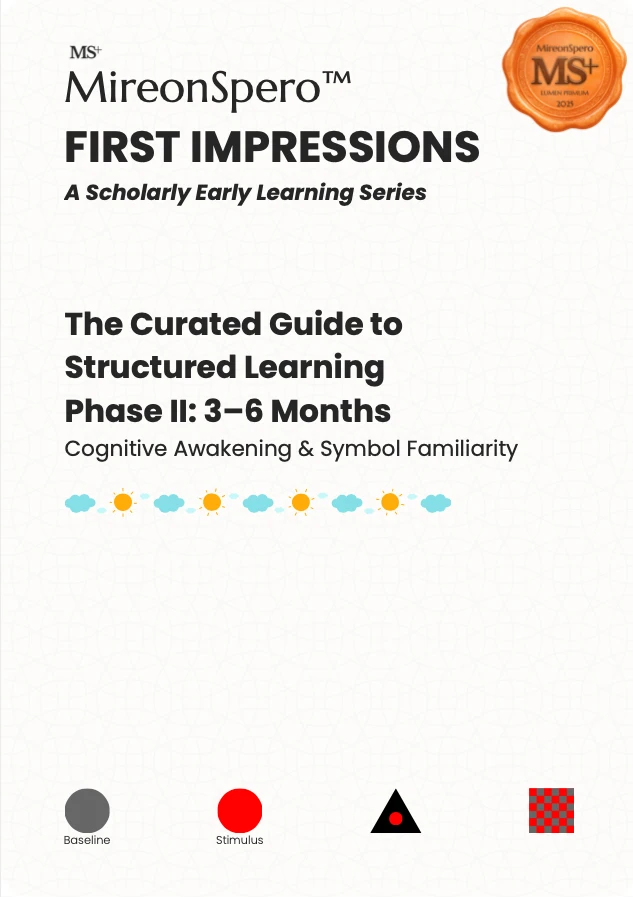
The caregiver's operational reference across the phase. The Guide frames each session within a coherent chromatic practice structure, providing the sequencing, pacing, and observational language that turn a moment of engagement into a deliberate act of guided development.
The structured reflection layer of the phase experience. These materials anchor what was observed, support continuity across sessions, and give the caregiver a disciplined record of the chromatic phase as it unfolds.
Each element has its role. Each role is necessary. The value of the set is in the integration of all three within one coherent structure of chromatic engagement.
What Happens When the Sequence Meets Readiness
There is a moment, and every caregiver who has moved through Phase II with structure will recognize it precisely, when something in the visual exchange changes character.
You are holding a saturated red target at the distance the Playbook specifies. This is not the first session. The weeks of structured engagement are behind you. And the child's gaze arrives at the card with a quality of attention that was not present before.
Their focus settles. It holds. The drift characteristic of the earlier weeks is absent. Their eyes find the chromatic edge of the card and stay.
The fixation has a different weight to it. Present, directed, returned.
What you are witnessing is the product of a visual system that has reached sufficient cone density to register chromatic contrast as a distinct signal. The red-sensitive photoreceptors have matured to a threshold that allows the chromatic boundary to present itself with clarity. The neural pathway that connects retinal response to cortical attention has fired with enough strength to hold the gaze in place.
The developing fovea is doing what it was always going to do. The conditions you established through structured engagement gave it something precise to respond to.
The doubt that accompanied the earlier weeks of the phase does not vanish. It becomes quiet. What took its place is not triumph. It is a specific, grounded confidence that arrives only through observation.
You have seen something real. You have been present for the first clear signal that chromatic discrimination is organizing itself.
The Shape of Days Built on Chromatic Intention
Something changes in the texture of the week after a structured Phase II practice is established.
The day has a perceptual shape now. The chromatic environment is no longer incidental. You have considered the visual surround with a different kind of attention. The dominant colors in the room, the contrast levels of objects within the infant's field, the quality of light across the materials used in sessions: these are no longer background details. They are elements within an organized chromatic architecture.
The sessions themselves are brief. They are measured in minutes, as they should be at this developmental stage. But they carry a precision that accumulates. Each week advances the chromatic exposure in the sequence the Playbook specifies. Each session occupies a defined place in the progression from the earliest red-dominant encounters through the fuller chromatic engagement of the later weeks.
These observations are not anxiety. They are understanding.
You begin to notice things that a less structured approach would not position you to notice. The way their gaze returns to a target that was removed and reintroduced. The way pursuit behavior changes as the phase advances. The eye beginning to track a slowly moving chromatic target with a smoothness that was not present earlier.
The evenings carry a different weight now. The uncertainty that lived in the opening weeks of Phase II has given way to something steadier. You are not wondering whether you are providing the right environment. You have organized the environment around a framework designed for precisely this developmental window.
Structure does not add to what you already bring as a guide. It gives what you already bring a precise direction, calibrated to what the developing visual system is organized to receive.

The Three-to-Six-Month Window in Full
Why This Window Is What It Is
The three-to-six-month period does not appear in the developmental literature as a significant chromatic window by convention or convenience. It appears there because the biology of cone maturation creates a genuine and defined period of chromatic emergence that has its own pace, its own sequence, and its own relationship to what comes before and after.
Before this window, the infant visual system is organized primarily around luminance and contrast. The perceptual work of Phase I, the discrimination of form, the establishment of fixation, the earliest tracking responses, establishes the attentional infrastructure on which chromatic perception will build. Color does not arrive into a blank visual system. It arrives into one that already knows something about attending to visual targets.
After this window, the visual system enters a period of increasing integration. Color, form, depth, and motion begin to operate as coordinated elements in the perception of objects and environments. The chromatic discrimination organized during Phase II becomes one channel in a richer perceptual system.
Developmental researchers do not describe the three-to-six-month chromatic window as optional enrichment. They describe it as a period of genuine biological significance in the organization of color vision.
Two caregivers, both present, both attentive, both invested in the same child, move through this window on the same calendar. One brings knowledge of the chromatic sequence and a designed framework for organizing chromatic engagement. Only one operates with the full architecture of what this window's developmental logic requires.

Phase II Within the Full MireonSpero™ Architecture
PrimoHue™ is the second phase of ten. Phase I established the visual architecture of attention, the cortical capacity to hold a form, to find an edge, to sustain a gaze on a target organized by contrast. Phase II receives that foundation and builds the chromatic layer upon it. The perceptual system that learned to attend in Phase I now learns to differentiate.
What follows Phase II continues the logic of increasing perceptual complexity. Phase III introduces the pairing of object and language, the moment when the child begins to receive a name alongside what they see. The system moves through visual context, through early symbolic reasoning, through phonological awareness, through abstract thinking, arriving in Phase X at the capacity for ethical reasoning and systems-level thought.
The journey through Phase II is complete in itself. You are not asked to commit to the full continuum today. The phases that follow will present themselves in the sequence that corresponds to where your child grows. PrimoHue™ is sufficient. It is purposeful. It asks only that the caregiver bring the structure this window requires to the three months it occupies.
That journey continues from the moment, already arriving or already passed, when a child's eyes found a saturated target and stayed. A first color, encountered with intention. A developmental window organized with care. The beginning of a chromatic world, entered through a designed framework rather than chance.
It begins with color.
What This Is, and What It Is Not
PrimoHue™ will not produce a child with advanced color discrimination.
It will not accelerate the maturation timeline of the developing retina or guarantee that chromatic differentiation emerges at a defined pace. It will not eliminate the natural variability of individual development within this window. It will not give the caregiver certainty about what the child's visual system is doing or will do.
It will give something more honest than certainty.
It will give the caregiver a framework for chromatic engagement that corresponds to what the developing visual system of a three-to-six-month-old child is biologically organized to receive. It will give the specific sequential logic of cone maturation a structured environmental counterpart, organized by someone who understood the biology before the materials were designed.
It will give the caregiver the observational language to watch chromatic development unfold with a precision that instinct alone does not provide. The parent who completes Phase II with structure arrives at Phase III with something that cannot be improvised retroactively: a continuous observational record of the child's chromatic development, a refined capacity to perceive the specific signals of visual responsiveness, and the particular confidence that comes from having brought a designed framework to a developmental window and watched the framework do what it was built to do.
The three-to-six-month window closes the same way whether or not a structured approach was present.
It closes differently when the caregiver knew the chromatic sequence and organized the conditions around it.
For the Guide Who Has Read This Far
You arrived at this narrative because a general approach to early visual development was not sufficient for what you understand this window to require. You understand, from everything set out above, that chromatic development in the three-to-six-month period is not incidental enrichment. It is the biological emergence of color perception, organized in a defined sequence, responsive to conditions that can be designed with awareness of what the developing retina is ready to receive.
You have been holding that knowledge without a system built around it.
Because this is the window. Right now, in the weeks your child is living, the cone cells of the developing fovea are maturing. The chromatic layer of perception is organizing itself for the first time. The capacity for color discrimination is either being introduced within a structured, sequenced framework or it is forming without one.
Both paths are present in every developmental window. Only one carries a designed framework.
The Three Ways to Begin
The foundational structure of Phase II. Calibrated chromatic reference tools, session anchors aligned with the cone maturation sequence, and a documented framework for consistent daily engagement. This is where principled chromatic practice begins.
Deepened engagement through sequenced chromatic progression protocols, tracking fidelity instruments, and fidelity-based practice across the full phase window. Every session is guided. Every observation has a frame. Consistency is built into the practice.
The most complete expression of Phase II. The full governing playbook. Environmental chromatic audit tools. Multi-caregiver coordination instruments. Extended auditory guidance. Long-form observational tracking across the three-to-six-month arc. At its center, the Contrast Calibration Playbook™: ninety days, structured week by week, from the first saturated red encounter to the close of the phase.
This edition does not do more for your child. It does more for you as the instrument through which your child's earliest chromatic development is guided. That distinction is the entire point.
A Note on the Enrollment Model
MireonSpero™ operates under an academic enrollment structure. Phase II is a complete developmental unit. Enrollment is a single tuition across the phase duration, structured as an enrollment in a defined developmental framework rather than as the purchase of individual materials.
This structure reflects the nature of what the guide is entering. You are not buying materials. You are enrolling in a phase of your child's structured developmental education, with all the seriousness and all the commitment that the word enrollment implies.
Tuition is final upon enrollment. No returns. This is the standard of every serious institution that asks its participants to arrive with full commitment rather than provisional interest. A caregiver who has read this narrative in full understands the basis for that standard.
The three-to-six-month window will not return. Not in a threatening sense. In the ordinary, irreversible sense of all developmental time. Each developmental window has its own architecture and its own timeline. The framework is designed to support the guide while that window is active.
The caregiver has one decision to make in the weeks this window occupies.
Not whether to love this child. That was decided before this page existed.
Whether to meet the emergence of color perception with the structure it deserves.
If the answer is yes, the enrollment is open.
MireonSpero™ First Impressions™ · Official Global Enrollment